


France’s sovereign risk has repriced. Corporate credit has been much slower to follow. Meanwhile, the hyperscalers are embarking on a borrowing boom that Matt King thinks has barely started.
Matt King calls his framework “The Great Deferral.” The former head of credit strategy at Citi, who now runs Satori Insights, sees strong corporate profits and persistent investor inflows keeping markets resilient—even as fiscal pressure builds, investment commitments grow and some borrowers postpone confronting their problems.
“The risk hasn’t disappeared, it’s been pushed into the tails,” Matt King (Satori Research).
That does not mean every tight credit spread is wrong. One of the more interesting parts of our conversation is King’s willingness to defend much of the corporate market’s pricing. His concern is what happens when risks outside the corporate balance sheet become risks to the corporate balance sheet—and whether investors will get much warning.
In this episode of Fixed + Floating, we discuss France, government borrowing, the financing of AI investment, private credit and what happens when money rotating between assets becomes money leaving risk altogether.
WHICH MARKET IS WRONG?
We open with a contradiction: French five-year CDS at about 80 basis points, OAT spreads to Bunds at their widest since 2011, and European corporate credit still near its tights. Those are the market levels discussed at the time of recording. Which market is wrong?
“I’m not sure either is wrong,” King says. “But at a minimum, there’s an underlying tension here.”
For much of corporate credit, he argues, profits remain strong enough to support tight spreads. That distinguishes the current market from earlier periods when he thought credit prices had become disconnected from deteriorating fundamentals.
“Mostly, I’d say credit has been following its fundamentals and more so than previously”, Matt King (Satori Research).
The more obvious concerns sit in CCCs, parts of private credit and particular pockets of the market—not uniformly across the corporate universe.
The problem is that the risks investors worry about most are increasingly sovereign, political and macroeconomic. Those risks do not necessarily feed into every corporate bond immediately. But there comes a point when the distinction stops holding.
“It’s that that gives rise to this underlying tension of, gosh, my spreads are really tight, but I still have this macro world where I’m worried about everything.”
THE BORROWER OF CONCERN HAS MOVED
King jokes that he has spent his career looking at bubbles—not through choice, but because the source of concern keeps moving.
Around the dot-com period, it was companies. Before the financial crisis, it was households, mortgages and the institutions financing them. Increasingly, it is governments.
“It’s governments where we worry about reaching a tipping point and that risk spilling over,” Matt King (Satori Research).
The uncomfortable part is the scale. Each successive source of concern involves a larger pool of debt. Sovereign distress can reach much further than problems confined to one segment of corporate borrowing.
Investors have also become accustomed to increasingly fast rescues.
King recalls about five weeks before aggressive easing and liquidity support around LTCM, about three weeks before measures such as TARP after Lehman, about five days during the UK gilt crisis, and a weekend for the SVB rescue package. These are his recollections, rather than a standardized comparison of policy-response times.
“We’ve kind of become addicted to government rescues and central bank rescues,” Matt King (Satori Research).
Meanwhile, governments struggle to take measures that improve long-term debt sustainability but impose short-term costs.
“The moment you try and do the right thing for the long term, some special interest group cries that they’ve been wronged, and then the governments end up backtracking.”
His conclusion: “This cycle will not be broken until the bond market shows who’s boss,” Matt King (Satori Research).
FRANCE AND THE KINK IN THE CURVE
For France, King sees a political constraint as much as a financial one.
“Voters have no appetite for seriousness, and any attempt at seriousness causes the incumbent to be thrown out”
He does not simply blame the governments under President Macron. He argues that they have attempted modest pension reforms and other measures, only to face opposition and retreat. Nor does he think lower energy prices alone would resolve the underlying fiscal problem.
For credit investors, the question is when sovereign pressure starts overriding company-specific fundamentals.
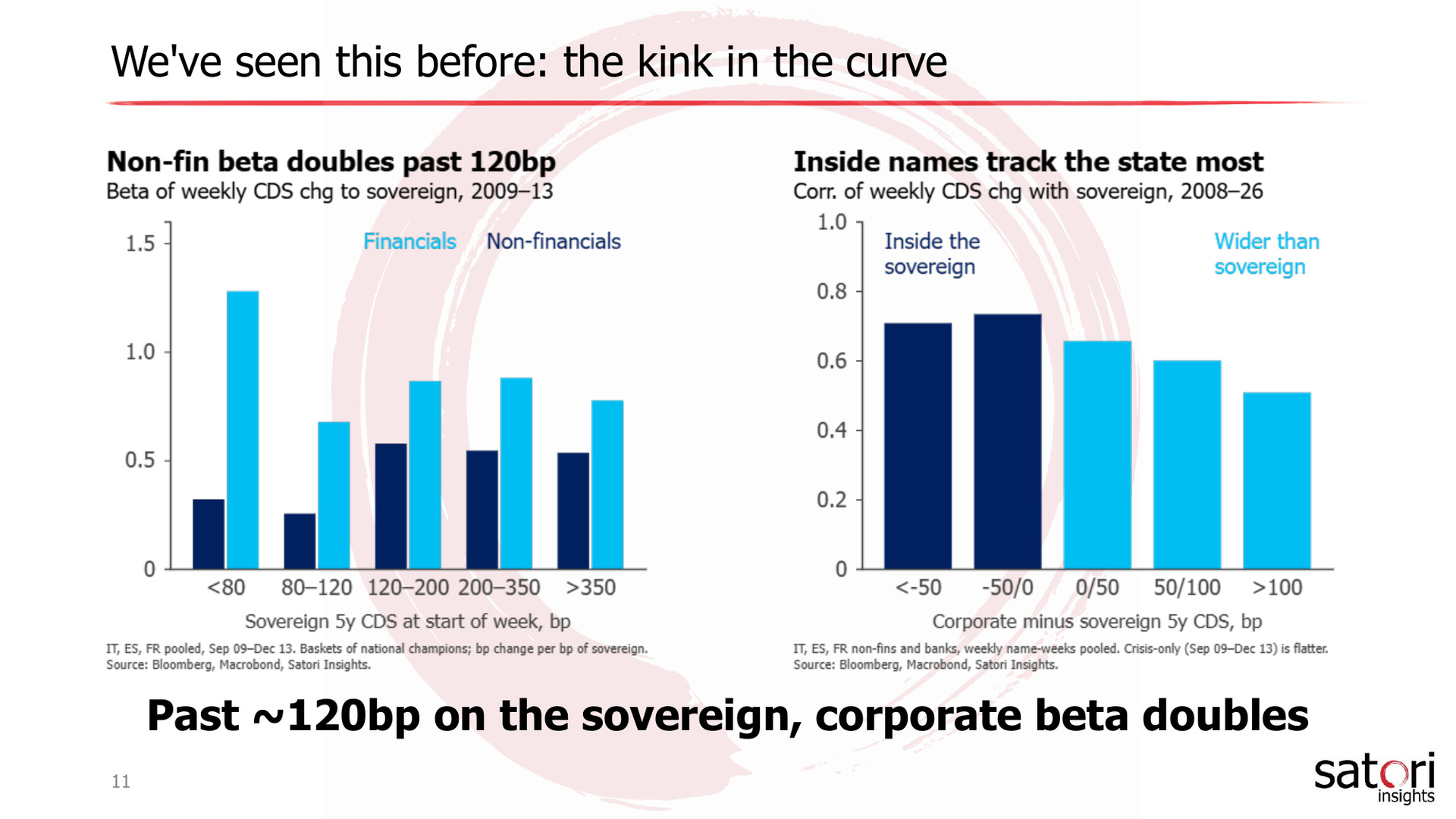
King points to work from the 2011–12 sovereign-debt crisis. At lower sovereign-CDS levels, corporate spreads could trade primarily on their own fundamentals. Around 120 basis points, the relationship changed: companies—and especially banks—became more closely correlated with the sovereign.
Banks are particularly exposed through government-bond holdings and the possibility of deposits leaving the country. Non-financial companies can remain more insulated, but not indefinitely.
“When sovereigns get into difficulty, they do change taxes, they do change laws, they do resort to sudden nationalizations.”
The roughly 120-basis-point level is a historical reference, not a universal trigger. King nevertheless thinks it helps explain why France’s sovereign stress has not yet translated into a much broader corporate-bond repricing.
His presentation describes France as still “left of the kink—for now.”
THE BORROWERS KEEP ISSUING. THE BUYERS HAVE A CHOICE.
France is part of a wider change in the bond market: the largest borrowers are not responding to rising yields in the way investors might expect.
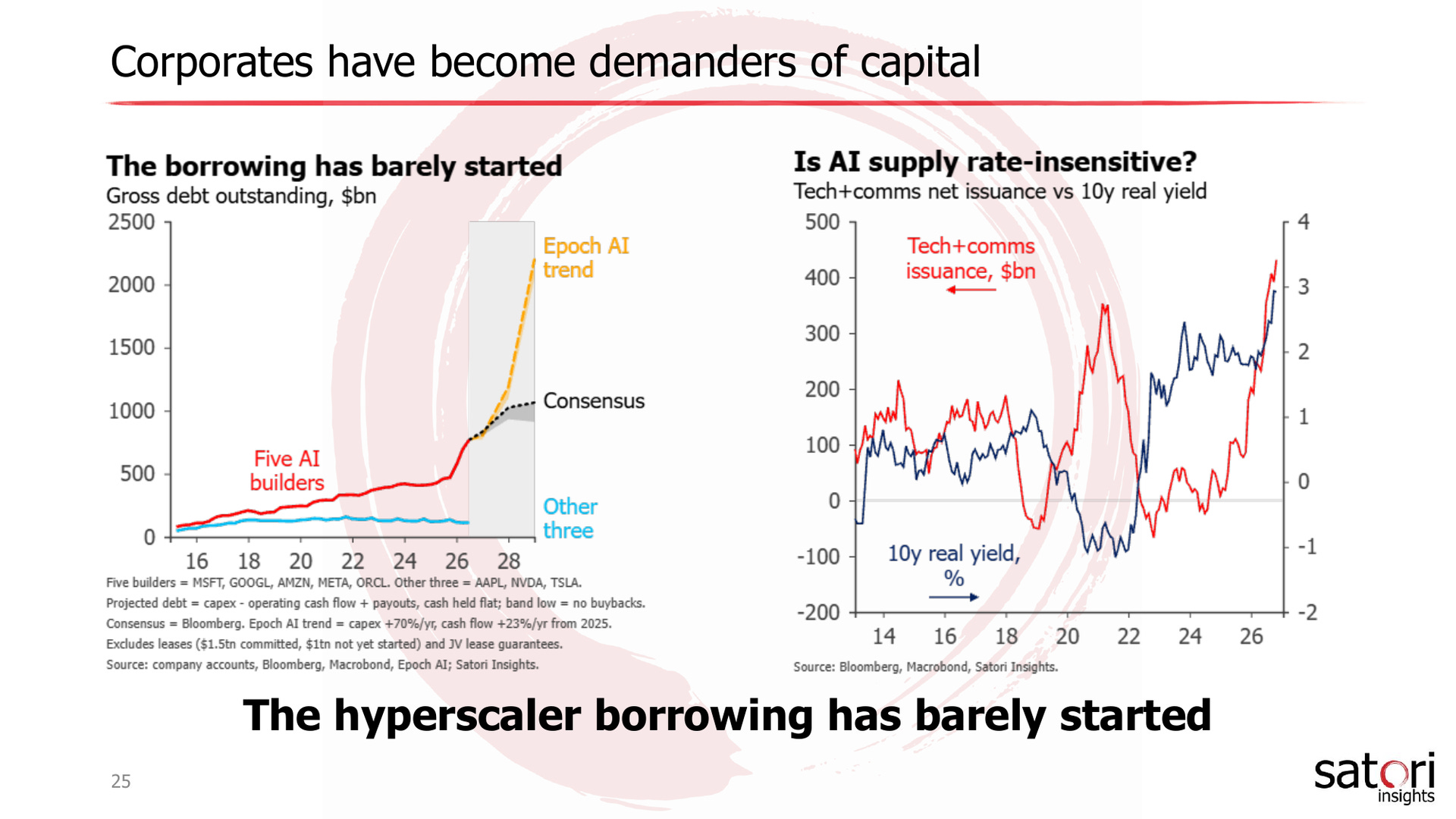
“Neither governments nor hyperscalers, so the big borrowers in fixed income, are yield sensitive for now, or sufficiently yield sensitive for now,” Matt King (Satori Research).
At the same time, buyers are becoming more price-sensitive.
Pension funds, insurers and central banks previously supplied substantial demand. Increasingly, the marginal buyer has more choice over where to allocate capital—and requires a higher yield.
“But the new buyers have a choice, and as a result, they demand a higher yield”
For governments, the pressure takes time to become visible because the interest bill adjusts as debt matures and is refinanced. But the mismatch between borrowers that keep issuing and buyers that demand more compensation can compound.
For hyperscalers, the mechanism is different. Expectations of future profits matter more than a modest increase in financing costs.
“What’s different about the hyperscalers is that, as the spreads and the yields have gone up, they haven’t cared”, Matt King (Satori Research).
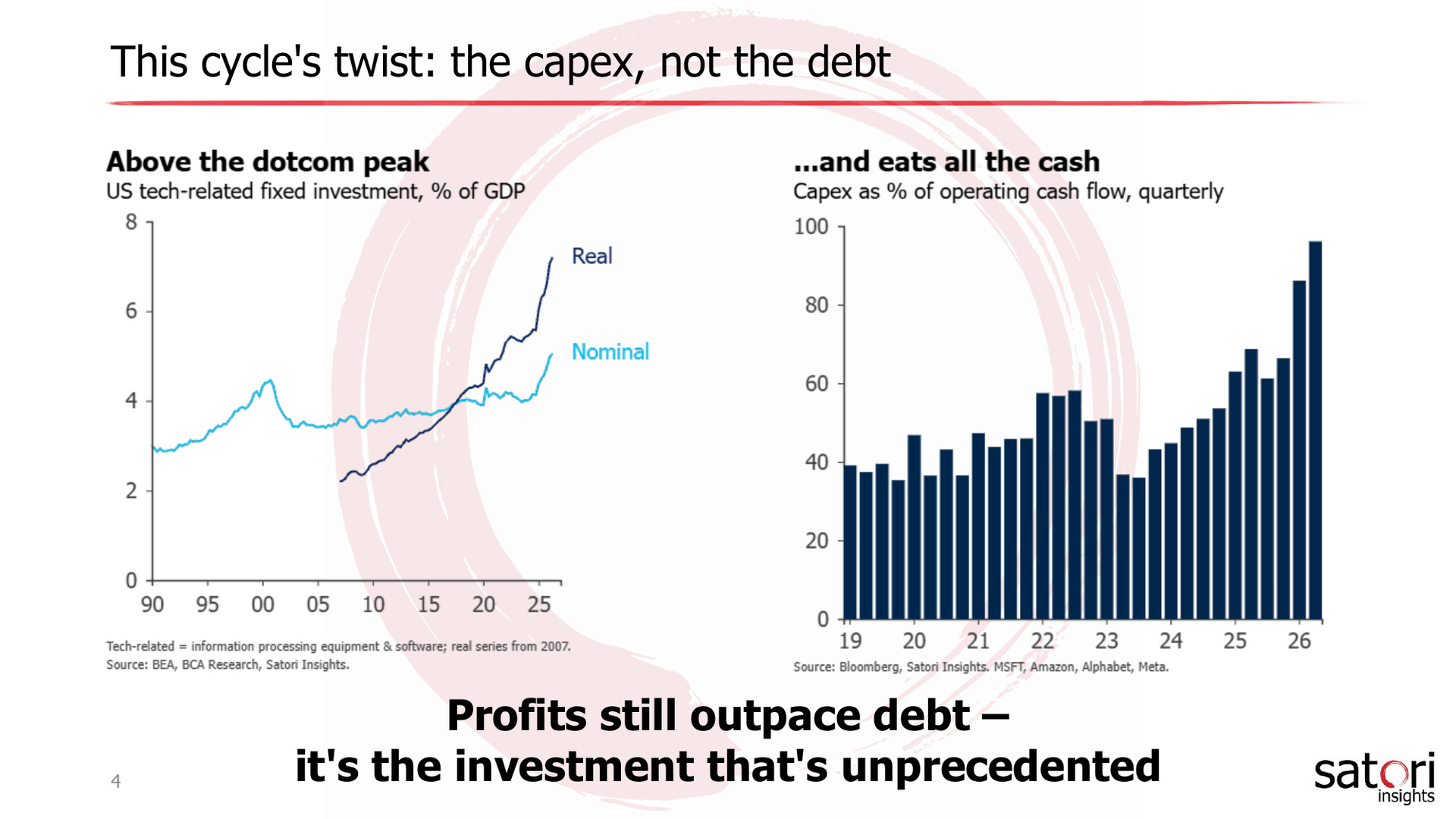
His deck describes the twist in this corporate cycle as “the capex, not the debt”: profits still outpace debt, while the investment is unprecedented.
This is not simply a story of already weak borrowers stretching their balance sheets. Strong issuers can sustain a borrowing cycle for longer—even while their issuance puts pressure on the rest of the market.
THE AI BORROWING BOOM HAS BARELY STARTED
How much more debt might the hyperscalers issue?
King cites consensus estimates of roughly $1 trillion of further issuance by 2028, and $2 trillion-type figures from Epoch AI. These are estimates he references, not a forecast developed in the interview.
The more important question is what would make the borrowing stop.
In what Silicon Valley views as a winner-takes-all environment, he expects the weight of issuance to continue until something breaks. His most likely candidate is confidence on the equity side.
Elevated equity valuations can make growing debt appear manageable. Investment spending also supports revenues and earnings elsewhere in the economy, extending the apparent strength beyond the technology companies themselves.
But free cash flow and off-balance-sheet commitments create a different picture for a credit investor.
“Suddenly you look at all of the debt that was issued, and then you realize it’s not as sustainable as you thought previously,” King says of the moment equity confidence changes.
He repeatedly stresses that we are not there yet.
I push back on the idea that less hyperscaler issuance must be bad for bondholders. If issuance falls because investment slows, reduced supply and lower real yields could support the bonds of stronger issuers.
A slowdown in financing demand and a collapse in confidence about the cash flows supporting the debt are not the same outcome. That distinction matters when thinking about who wins and loses if the AI investment cycle turns.
MONEY ROTATION, NOT JUST MONEY CREATION
If central banks have been draining liquidity, why have markets continued to rise?
King separates two questions: how much money or credit is being created, and where investors choose to put it.
Since 2024, he thinks the break from central-bank liquidity has been most obvious in equities, less pronounced in high yield and barely apparent in investment grade.
Aggregate credit creation is not exceptionally strong by historical standards, he argues. The more extraordinary feature is investors’ willingness to allocate money to risk assets.
“That exuberance or willingness to take risk is just off the charts,” he says. Investors have been “educated to buy dips” and to expect central banks to intervene if necessary.
This does not mean money creation has become irrelevant. King explicitly argues that fiscal activity has been an important source of credit creation, especially in the US. He also describes money-market funds financing government borrowing and supporting the expansion of repo and the Treasury basis trade.
He puts US repo at about $7 trillion, more than double its level in 2022.
His concern is less that every leveraged position is inherently unstable than that funding pressure and correlated positioning could cause investors to move together.
“The main risk that they point to is a liquidity shock more than a credit shock.”
DEFAULTS DEFERRED, NOT AVOIDED
The other part of the deferral occurs within individual credits.
Weak covenants, refinancing and liability-management exercises can postpone a conventional default without preserving the value of the original creditor’s claim.
King argues that default measures need to account for LMEs, including transactions described as voluntary that nevertheless impose significant losses on lenders. He also questions the incentives of private-equity-owned borrowers that use improving profits for dividend recaps rather than sustained deleveraging.
When problems are postponed, eventual recoveries can be worse.
“We’ve abandoned the covenant, so nothing defaults, but at the same time, when we get the defaults, the recovery rates are really low,” Matt King (Satori Research).
Abundant liquidity can reinforce the process. An analyst may consider a credit expensive, while a portfolio manager receiving inflows still needs to deploy capital.
“What that gives you is stuff that should have been defaulting priced to par, and then when you do get the default, yeah, the cliff is all the steeper.”
But there is an important qualification.
I ask whether the public market already recognizes the weak borrowers: CCCs trade much wider while the rest of credit remains tight.
King agrees—to a point. There is not just a cliff in spreads. There is also a cliff in fundamentals. BB and B profits remain strong.
For those liquid credits, he says, “if there’s a bubble, it’s a bubble in earnings and not just in markets being distorted.”
PRIVATE CREDIT: THE GATES ARE HOLDING
In private credit, King sees a different reason problems can take longer to surface: investors cannot necessarily withdraw their money.
Redemption gates reduce the immediate risk of a run and allow time for assets to be refinanced or problems to be worked through. They do not establish that the assets are correctly valued.
“It does leave you with the lingering feeling, is this really marked correctly?”
One possible transmission channel is that investors sell what they can, rather than what they would prefer to sell.
“It could get to the point where you pull your money out of the liquid fund because you can’t pull it out of the illiquid fund,” King says. “But we’re not there yet.”
That qualification runs through the conversation: postponement can buy time, but it can also leave the eventual adjustment concentrated in a smaller number of more severe outcomes.
WHEN ROTATION TURNS TO EXIT
What would change King’s view?
“Outflows. That’s easy.”
Higher rates should affect both borrowing decisions and asset allocation. It is one thing to buy credit or equities when cash earns nothing; another when a bank account or money-market fund offers 4–5%, as in the comparison he makes during the interview.
Yet inflows have remained remarkably resilient.
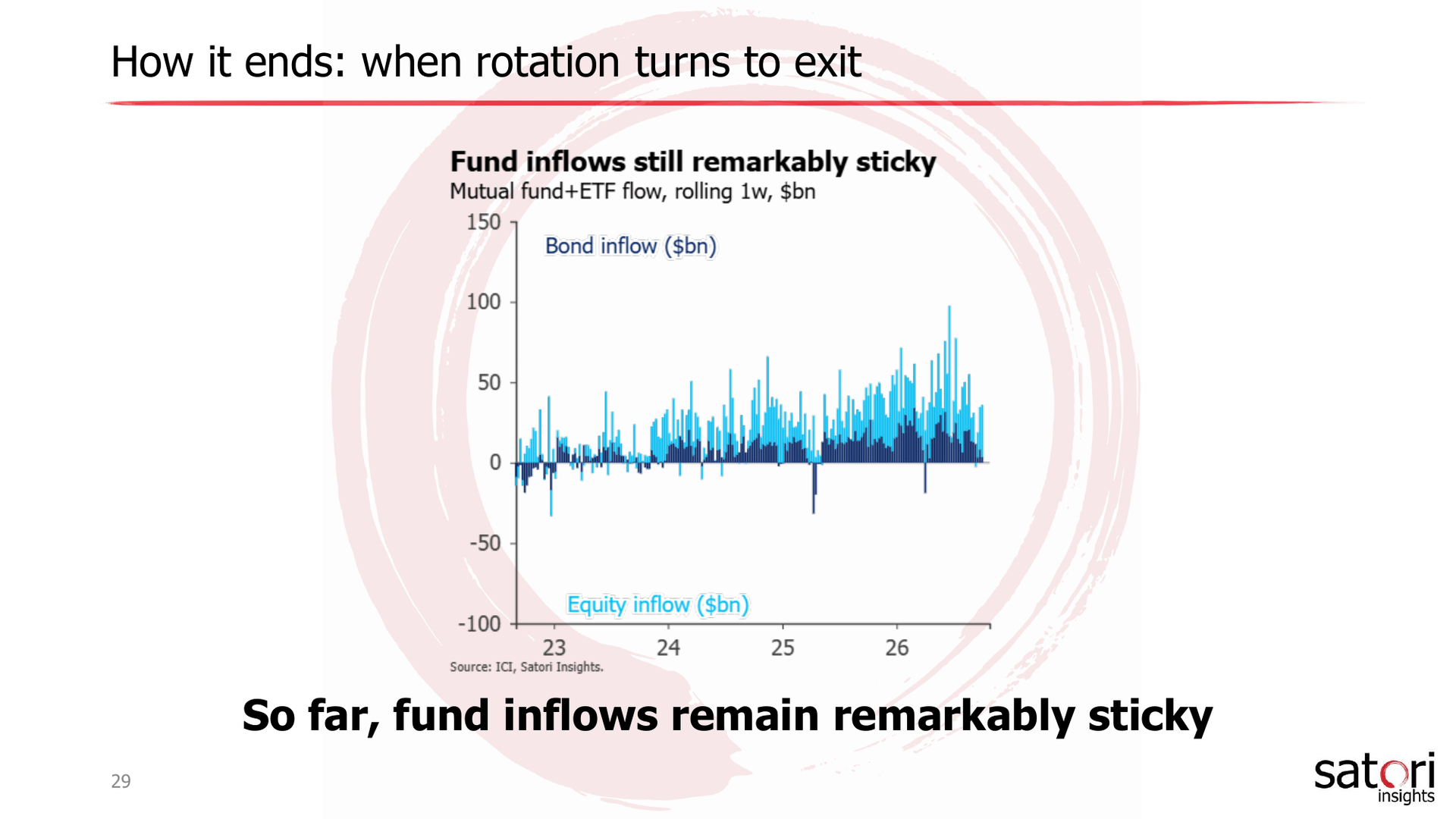
King’s concern is a feedback loop: investors withdraw money, prices weaken, financing conditions and fundamentals deteriorate, and cash becomes more attractive—prompting further withdrawals.
That self-reinforcing exit is what he thinks has largely been missing from this cycle.
He uses two images to describe a market that absorbs pressure until it does not: a ball in a bowl, and a brick attached to elastic.
“You pull and pull and pull and nothing happens, and then suddenly it comes and hits you in the face.”
MATT KING ON…
JAPANESE SELLING
King does not dismiss Japan’s influence, but he thinks direct overseas-bond selling is too small to carry the whole explanation.
“We’re talking tens of billions, we’re not talking hundreds of billions.”
The broader influence of rising Japanese yields, term premia and repatriation concerns may matter more than the direct flows.
REAL RATES
King is skeptical of the reassuring explanation that rising real rates are simply a sign of stronger growth.
He emphasizes renewed demand for capital: government spending, infrastructure, defense, supply-chain diversification and hyperscaler investment. The private sector increasingly wants physical capacity, rather than the asset-light model rewarded in earlier decades.
THE COST OF BEING RESPONSIBLE
Protecting a portfolio against an abrupt adjustment is difficult when the market continues rewarding momentum and dip buying.
“Responsible investors everywhere are going out of business,” King says, describing the pressure on investors who have worried about the macro backdrop and underperformed those taking more risk.
His discussion of positioning centers on cheap convexity and exposures that could respond to sovereign stress. But professional investors face two risks: losing money in a downturn, and losing assets under management by being too cautious during the continued upturn.
ABOUT THE GUEST
Matt King is the founder of Satori Insights and a global markets strategist. Previously Global Markets Strategist (and previously Global Head of Credit Strategy at Citi and Head of European Credit Strategy at JPMorgan.
His research connects credit markets, liquidity, investor flows and the wider macroeconomic environment. In this episode, he presents his October 2026 framework, “The Great Deferral.”
https://www.linkedin.com/in/matt-king-0147194/
https://www.linkedin.com/company/satori-insights/
SUPPORT MATERIAL

Fixed + Floating
Fixed + Floating is a credit podcast hosted by Portfolio Manager Josef Pschorn. Long-form conversations with credit market practitioners - portfolio managers, analysts, restructuring advisers and academics - on private credit, high yield, distressed debt, CLOs, liability management and credit policy.
Subscribe to Fixed + Floating on YouTube · Spotify · Apple Podcasts
Follow Fixed + Floating on X · Fixed + Floating on LinkedIn
Follow Josef on LinkedIn
If there is a guest or a topic you want covered, reply to this post or message me on LinkedIn.
Fixed + Floating is for informational purposes only. Not investment, legal or tax advice. Guest views are their own and do not represent their employer.


