


A US credit fund running $13bn has one analyst covering Europe. He can work on three or four situations. Everything else fails on liquidity before the credit work starts: a 5% position in a EUR 400m issue is EUR 20m, which is 0.15% of the fund. Even a double from there adds 15bp. No outcome on a position that size pays for the research effort.
Now take the same market from a fund of a few hundred million. A EUR 400m single-bond capital structure is the core hunting ground, and sell-side coverage of those names has thinned over the past decade, so fewer people are doing the work than were doing it ten years ago.
That is the standard case for a boutique. What I had not worked through before this conversation is that the same size advantage turns into a disadvantage once a credit gets into trouble.
A small fund can buy issues a large fund will not bother with. It cannot get onto a creditor committee, because a seat requires holding a meaningful share of the debt, and in a large capital structure that is more money than the fund has. So the small fund has an edge while the credit performs and no influence once it restructures.
That would matter less if restructurings were rare. They are not. Companies now return to the table faster than they used to, which means more of a credit’s life is spent in the phase where a small fund has no say. The set of names such a fund can responsibly own has shrunk, and none of those credits had to deteriorate for that to happen.
The rest of this piece is a structured walk-through of the sequence a name has to survive before it becomes a position, the arithmetic that caps how large that position can be, and why the set of eligible names keeps getting smaller.
Two Managers, One Credit — Why the Mandate Precedes the Analysis
Virgin Media O2 carries roughly 22bn of debt. Holding 5% of that structure costs 1.1bn. A fund of a few hundred million cannot get there, so it cannot sit on a steer holder committee in that name under any circumstances.
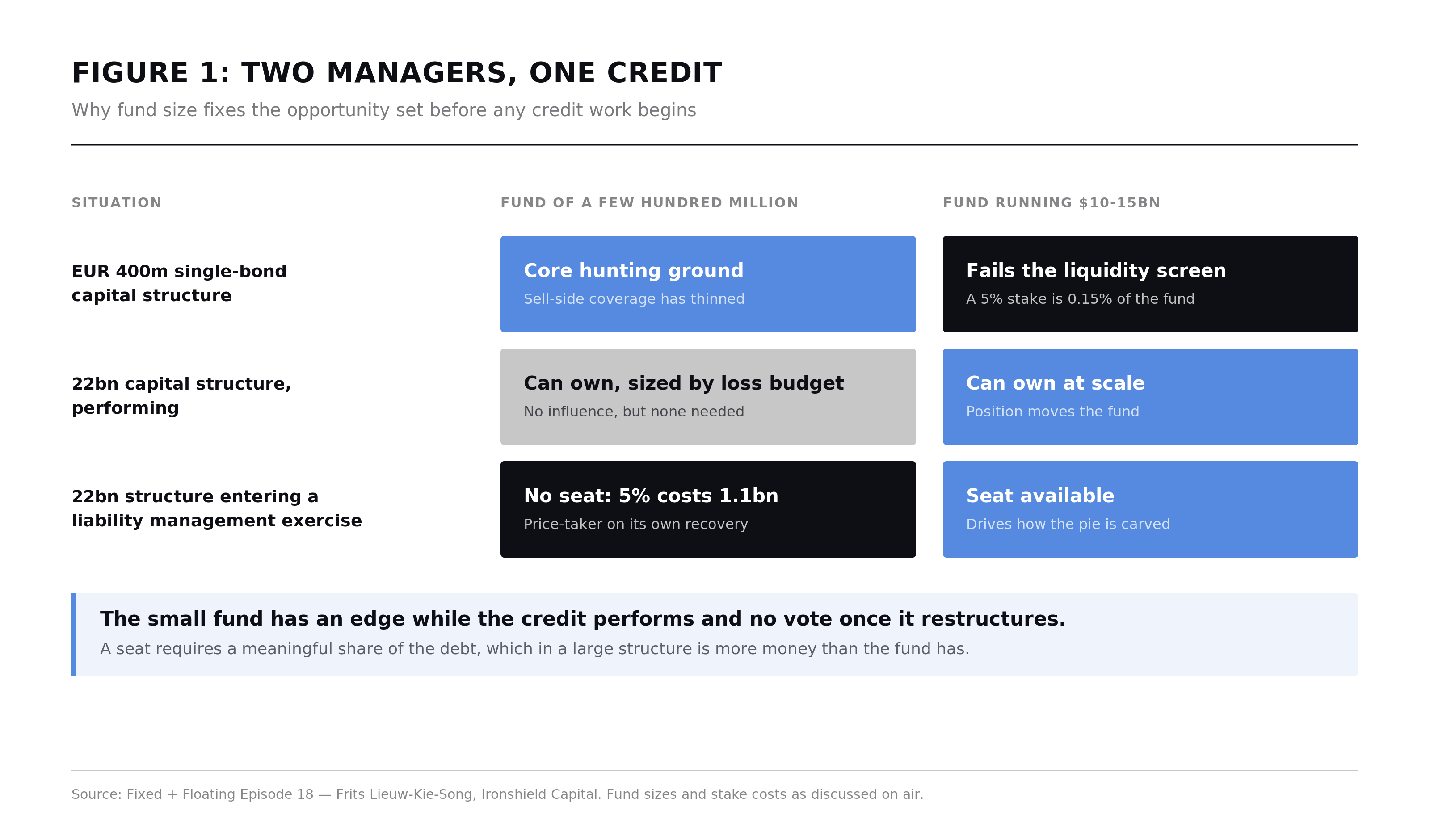
That is the constraint Frits Lieuw-Kie-Song of Ironshield Capital described, and it is not an information problem. The advisors know who the large holders are, and so does everyone else in the market; the identity of the drivers is not the secret. The point is that he cannot be one of them. In a 22bn structure his fund is a price-taker in a negotiation over its own recovery, so his rule is to be involved only where he can hold enough to drive the process, and to stay out otherwise.
The same constraint runs the other way lower down the size range. A boutique can enter EUR 400m names the large fund will never open a file on, and has to exit names the large fund can sit inside comfortably. Neither is running the better strategy. They are running different perimeters, and the perimeter fixes the opportunity set before a single number is checked.
Inside that perimeter a name still has to survive an ordered sequence, and the order matters more than any individual step. Building the model early is the most common way to lose two days, because it commits the research time before the eligibility questions have been answered.
The Sequence — Seven Questions Before a Name Becomes a Position
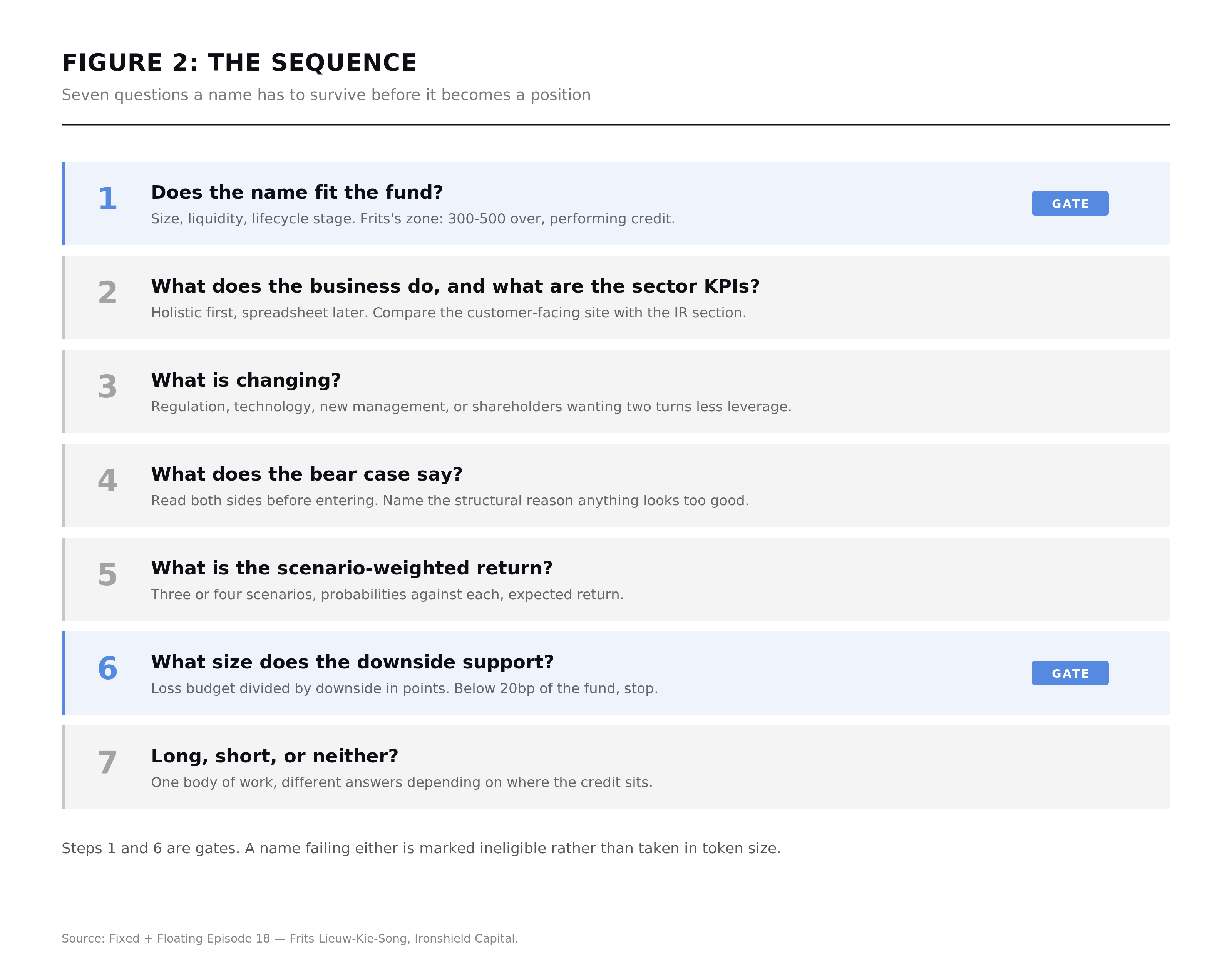
1. Does the name fit the fund?
Can it be owned or shorted in size that matters? Is liquidity adequate at that size? Which stage of the lifecycle is it in — performing, stressed, or close to an exercise where a committee seat becomes necessary? Frits’s stated zone is 300-500 over, performing credit, deliberately upstream of the workout desk that Ironshield’s flagship special situations fund covers. If the name fails here, stop.
2. What does the business do, and what are the sector KPIs?
Understand the business before touching a spreadsheet: what it sells, how customers and competitors see it, whether the product is growing, whether regulation or technology is moving against it. Then reduce the sector to the variables that drive margin.
Read the customer-facing part of the company’s website, then read the investor relations section. If the two describe a different business, that gap is the first red flag.
3. What is changing?
Value comes from a change in the business, not from a bond looking cheap against comps. The change can be external — regulation, technology — or internal: new management, shareholder pressure, a badly run company being fixed.
The best version is a change in what the shareholders want. Shareholders normally want dividends and acquisitions, and bondholders want neither. Occasionally the equity holders conclude their shares are worth more with two or three turns less leverage and the M&A stopped. For as long as that holds, both sides want the same outcome: leverage falls, spreads tighten, and the tightening has a cause you can name. Identify it before the market does and the position runs for several quarters.
4. What does the bear case say?
Read both sides before entering, not after. If the short case against a long you like is weak, that is the setup — particularly when the bond has been sold hard, because the selling is then either technical or a misunderstanding, and you can be paid for both.
The negative version of this came out of WorldCom, one of the largest losses of Frits’s career. The numbers looked excellent, EBITDA margins ran well above AT&T’s, and it was a fraud with a recovery close to zero. The rule that survived it: when something looks too good to be true, name the structural reason for it — a monopoly, a patent, a real cost advantage. If you cannot name it, you do not own it.
5. What is the scenario-weighted return?
Only now does the model appear. Cash flow projections, three or four scenarios covering improvement, stasis and deterioration, probabilities against each, and an expected return. The sense-check Frits applies alongside it has nothing to do with multiples:
If you say you will go and sail around the world for a year, which of the investments are you not worried about? Which do you think will survive, whether the market is up or down ten or fifteen percent, just because the business model is robust and they’ve got a strong balance sheet?
6. What size does the downside support?
Apply the arithmetic in the next section. If the answer is too small to matter to the fund, go back to step 1 and mark the name ineligible rather than taking a token position.
7. Long, short, or neither?
The same credit can be a long at one point in its life and untouchable at another. Virgin Media O2 is the example: a business Frits currently reads as a melting ice cube, a name he could build a long case for in the front-end 2029s if sentiment turns, and one he expects to be out of entirely if an exercise arrives. One body of work, different answers depending on where the credit sits.
Exit discipline
Three situations, three different responses:
• The thesis is wrong — a fact misread, a business misunderstood. Cut immediately, regardless of price.
• The thesis is intact and the position is moving against you. Scale down as it approaches the loss budget instead of making one all-or-nothing decision at the end.
• The position has breached the budget and you like it more than when you put it on, because it is ten points cheaper. At Ironshield this goes to a committee of the portfolio manager, the CFO and the CIO, and the decision has to be unanimous.
If you and I talk and we have the same investment philosophy, and I really like a position, I should be able to persuade you. If I can’t persuade you that it’s a good position, then maybe it’s not such a good position after all.
Conviction is lowest exactly when you are asked to defend it, because the market has spent a month telling you that you are wrong.
The Arithmetic That Caps a Position
The conventional order is to find the name, do the work, form a view, then size. Running step 6 as a gate instead of a conclusion changes which names reach the model at all.
Start with what the position loses in the bad case. A front-end bond bought in the nineties that ends in a restructuring costs 30-40 points. Set against that a loss budget — the maximum any single position may cost the fund. Frits works to roughly 50bp, and it flexes by situation; one position last year was set at 30bp.
Maximum position size (% of NAV) = loss budget ÷ downside in points
A 35-point downside against a 50bp budget caps the position at 1.4% of the fund, before anything has been said about how much you like the trade.
The short side behaves differently, and this is where the calculation is most often done badly. Frits frames the downside on a short of a par bond with two years to run as the present value of two years of coupons. That is the correct standalone accounting, but it overstates the constraint inside a long-biased book, because the long positions generate carry that covers most of the coupon paid away on the short. What is left is the capital loss — how far the bond can appreciate against you — and on a two-year bond already at par that is three or four points.
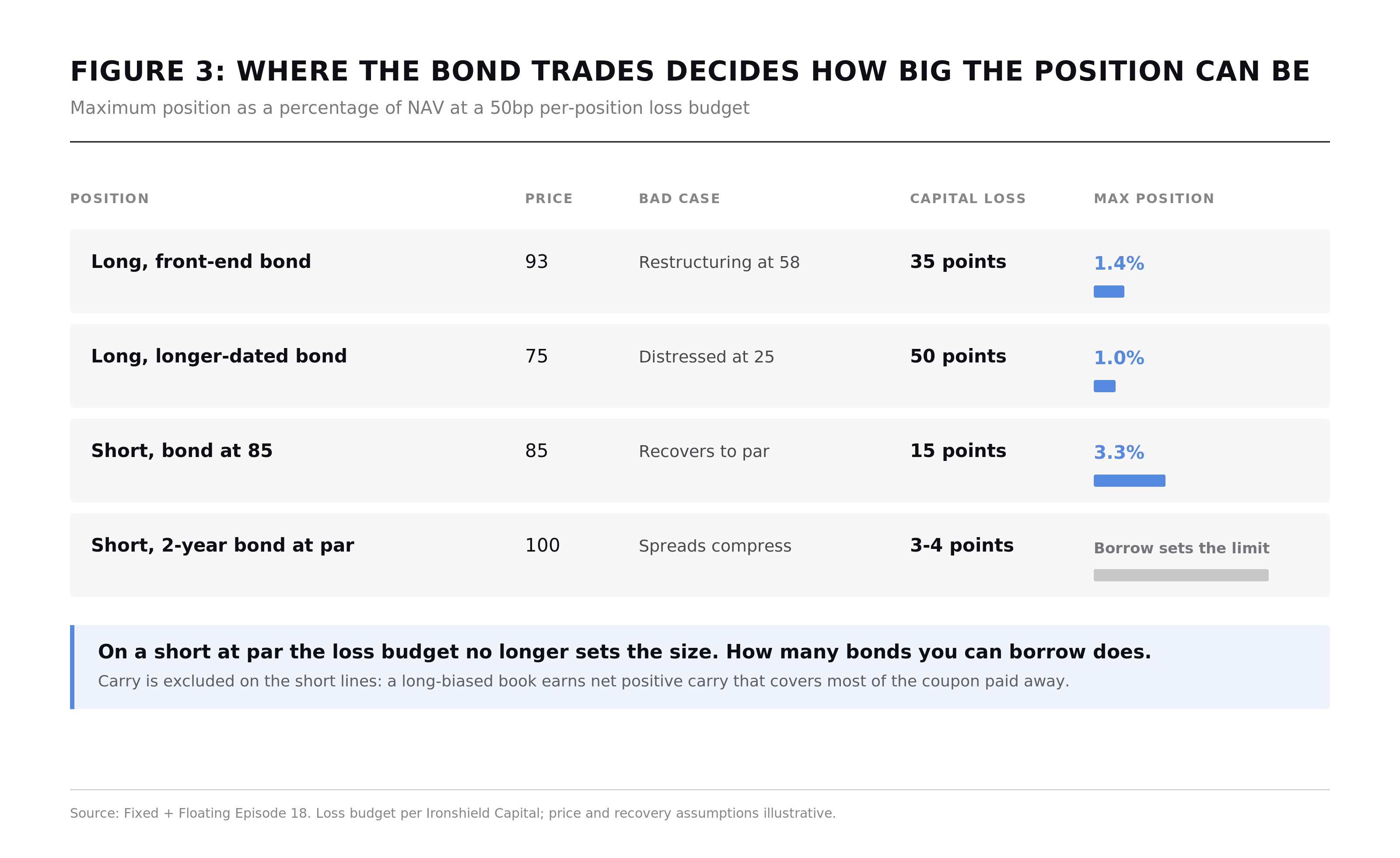
The last line is the useful one. At three or four points of capital risk the 50bp budget permits a position larger than any book would run, so the loss budget no longer sets the size. How many bonds you can borrow does.
The same arithmetic screens the research list. If the loss budget only supports 20bp of the fund, the position cannot add performance, so the work is not worth doing.
Why the Short Side Clears a Higher Bar
A long/short credit book is not built to a target ratio. It gets built from what clears the perimeter, in three layers: core longs where value is stable or improving and the return is asymmetric; selective shorts where the business is structurally weaker than the market believes; and tail hedges against dislocations that would be expensive to cover through single-name shorts.
The second layer stays small because a short has to clear three hurdles.
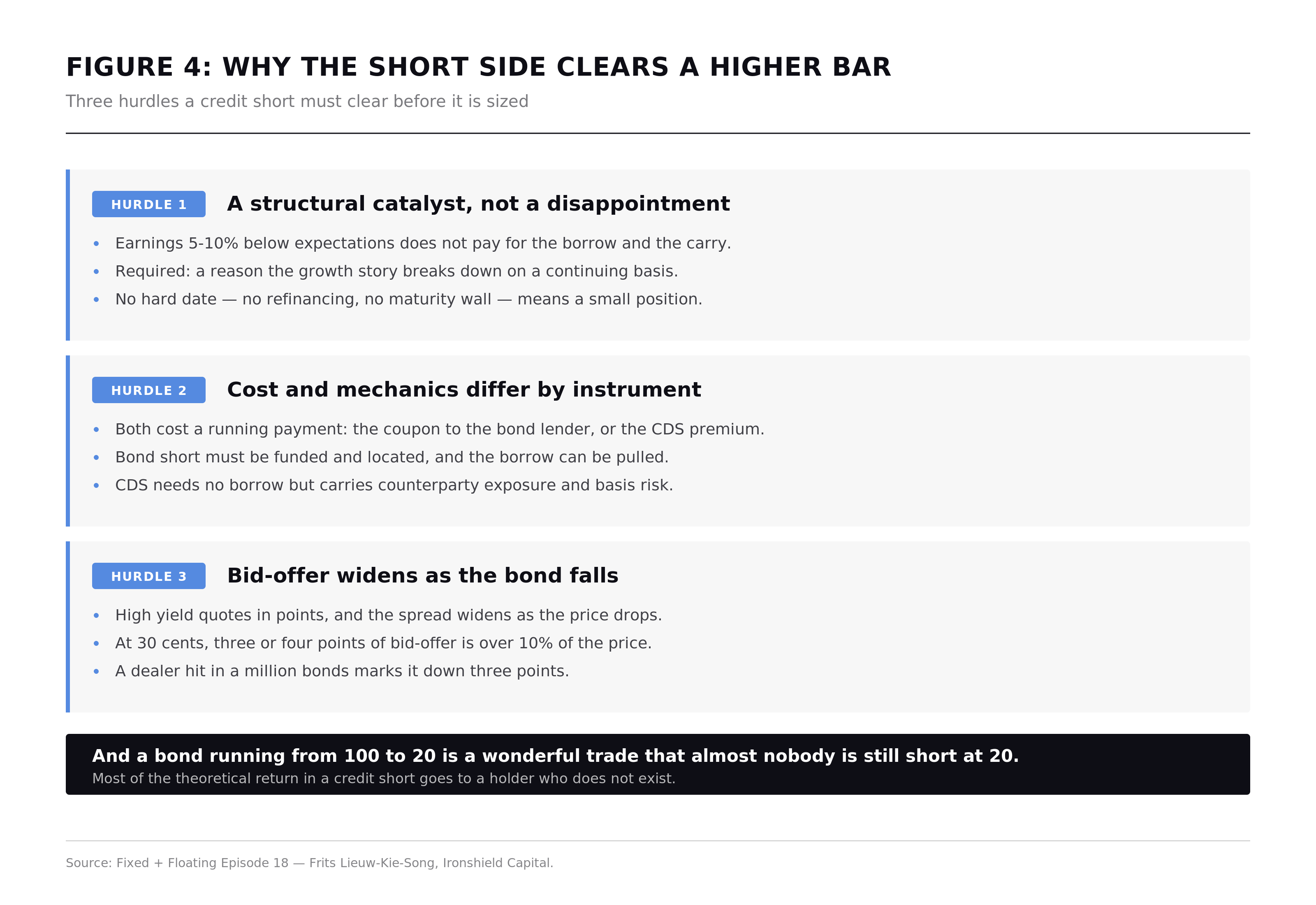
There is a behavioral version of the same problem. A bond running from 100 to 20 over two years is a wonderful trade, and almost nobody is still short at 20. Most of the theoretical return in a credit short goes to a holder who does not exist.
Shorts therefore fail the eligibility test more often than longs, the book ends up net long, and the work a balanced pair book would have done has to happen somewhere else.
That somewhere else is the overlay. Frits hedges the tail with out-of-the-money put spreads on equity indices, 5-15% out, six months, rolled to stay at that part of the curve. Hedging high yield with high yield removes the exposure he is paid to hold. His supporting number: since 1989, global high yield hedged into euros has been down in five calendar years against six for BBB- European credit, and high yield outperformed over the period. The hedge is there for the tail, not for the beta.
Reducing a Sector to Three Numbers
The most useful analytical habit in credit is reducing a sector to the variables that decide the outcome, then monitoring only those. Telecom and cable make the point cleanly, because the business is subscribers multiplied by ARPU, adjusted for churn. Those three drive the margin and, as Frits put it, really nothing else does.
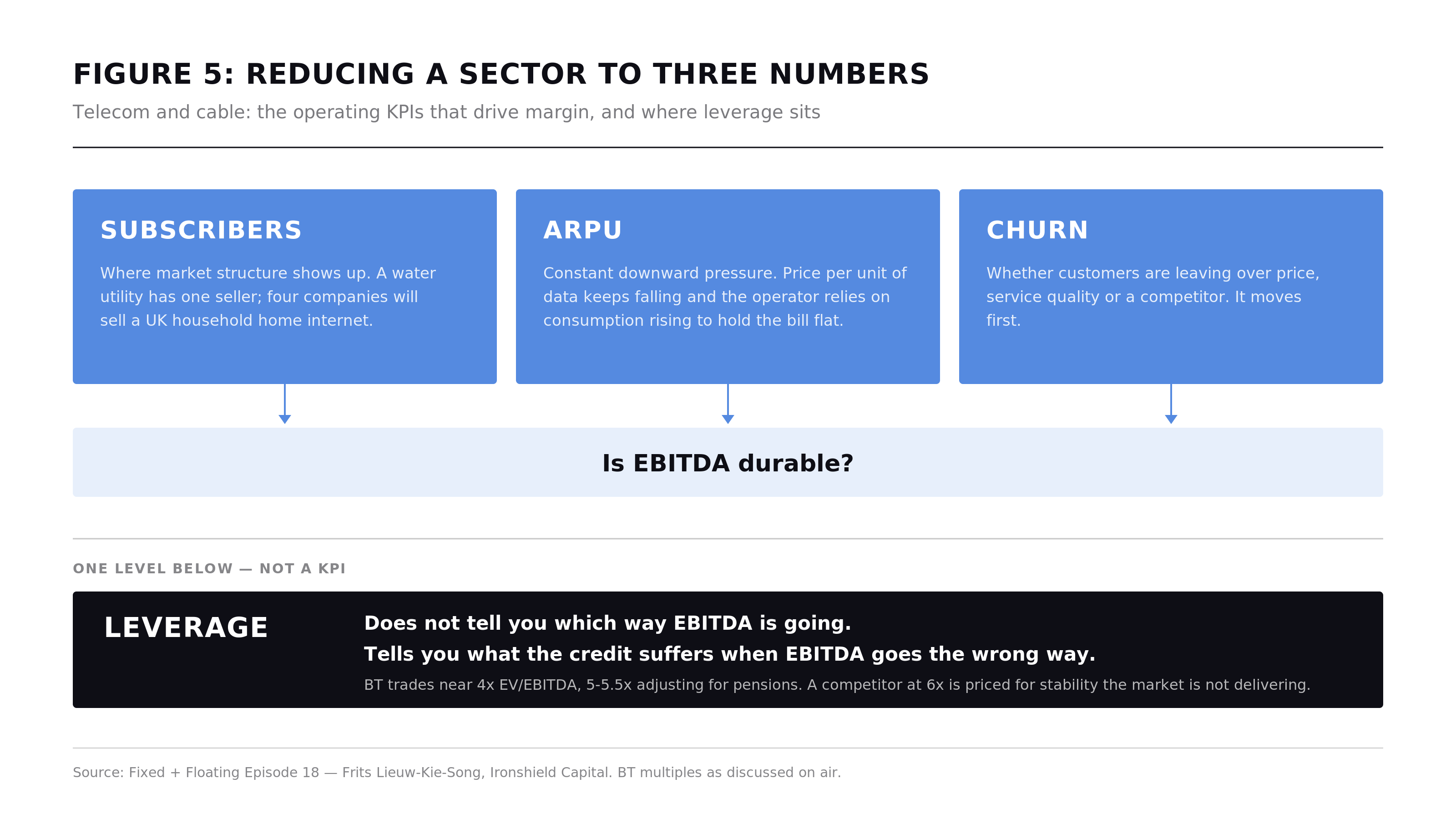
Each has a driver underneath it, and that is where the analysis happens:
• Subscribers is where market structure shows up. A water utility has one seller. Four companies will sell a UK household home internet, and the multiple the market once assigned on utility logic does not survive that.
• ARPU faces constant downward pressure, because the price per unit of data keeps falling and the operator is relying on consumption rising fast enough to hold the monthly bill flat.
• Churn shows whether customers are leaving over price, service quality or a competitor, and it moves first.
Leverage is not a fourth KPI. Subscribers, ARPU and churn tell you whether EBITDA is durable. Leverage tells you what happens to the credit when it is not.
UK telecom shows both halves at once. BT, listed, trades around 4x EV/EBITDA, or 5-5.5x adjusting for pension liabilities. A competitor carrying 6x against that comp is priced for a stability the market is not delivering. Liberty Media ran Charter and its European holdings at 4-5x for years and made a great deal of money doing it, which is much of why the same playbook was held onto here for too long.
The Perimeter Has Narrowed — What Changed in Liability Management
A pre-COVID restructuring did operational work alongside balance sheet work. It was the moment a company handed back leases, closed loss-making segments and reset the cost base, because the process carried the authority to force those things through. The co-op-driven exercises that replaced it are built for speed and paid on execution. Documents get rewritten, the company returns to the market, and the operating problem sits where it was. Level 3 and Carvana worked, and their success is much of why the template spread.
I put a figure to Frits that I had from Ed Altman on this show: roughly 50% of companies completing an exercise are back in one within three years. His number is a median of about one year, and shortening.
That changes what a name is worth to a small fund. If the first exercise is the opening move rather than the resolution, holding the credit through it requires influence over the next one. Influence requires a seat, a seat requires size, and size is capped by the arithmetic in Figure 1. For a book of a few hundred million, a credit with real exercise risk is often ineligible in both directions: too small to be in the room, too exposed to sit outside it.
The pie is the pie. The company is worth what it is worth, and in the LME it gets carved differently — and it doesn’t get carved according to the original docs, or the spirit of the docs.
Remember, none of these credits had to get worse for the opportunity set to shrink. Names simply spend more of their life in the phase that requires scale. I do not think that is priced anywhere. Spreads compensate a holder for default risk and for illiquidity. I have yet to see one that compensates a holder for having no vote in the negotiation that sets the recovery.
What I Take Away From This — And What I Will Be Watching
1. The reachable market has narrowed for a small book without a single credit deteriorating, and I do not think that is in the price. More of a credit’s life is now spent in the phase where a few-hundred-million fund has no vote, so more names are ineligible even when the analysis is good. Frits draws that boundary explicitly and declines the situations that fall outside it. I recognize the first half from my own book at XAIA. The second half I have been slower to accept, because turning down a name I have already analyzed and like still feels like giving something up rather than staying inside a boundary.
2. Reduce every sector to the three or four numbers that move the margin, and keep leverage out of that list. In telecom it is subscribers, ARPU and churn, and a monitoring routine built on those three catches deterioration earlier than a quarterly model rebuild does. Leverage sits one level below: it does not tell you which way EBITDA is going, it tells you what the credit suffers when EBITDA goes the wrong way. Running the two together is how a 6x structure gets defended as cheap against a 4x comp while subscriber numbers are already falling.
3. Holding through the whole lifecycle and relying on being large enough when it counts is what most large managers are doing by default rather than by decision, and it has not been tested. The exercises of recent years have mostly happened in markets with a bid underneath them. A median return to the table of one year has not had to survive a period when nobody wants to fund the next one. That is what I will be watching: not default rates, but whether the co-op template still works when the incremental money is unwilling. If it stops working, a committee seat becomes worth considerably more, and the perimeter narrows again.
This article is based on Episode 18 of Fixed + Floating, featuring Frits Lieuw-Kie-Song of Ironshield Capital. The views expressed are those of the speakers and do not constitute investment advice. For more information, please visit ironshieldcapital.com.
Fixed + Floating is the premier podcast for institutional investors and finance professionals exploring the forces shaping global credit markets. Hosted by Portfolio Manager Josef Pschorn, the show features conversations with leading voices from investing, research, and academia. We analyze the technical mechanics of High Yield, Private Debt, and Distressed Situations — from covenant evolution and liability management to macro policy impacts on credit cycles — providing forensic depth for the global fixed-income community.
Support Material:
