


The European chemicals downcycle has exposed fundamental weaknesses in overleveraged capital structures across the sector. As we explored in our previous analysis with Tim Riminton(E4), persistent oversupply from Chinese capacity additions has compressed margins globally, pushing leverage to unsustainable levels at multiple issuers.
INEOS Group Holdings (IGH) and INEOS Quattro—the two main debt-issuing entities within Jim Ratcliffe’s private conglomerate—exemplify this stress, but their credit profiles have diverged sharply. IGH benefits from Project One, a €4.8 billion ethane cracker expected to deliver €700 million in annual EBITDA from 2027 regardless of market conditions. Quattro's bonds rallied yesterday after news broke of a secured financing transaction and €200 million equity injection to assist with the €1 billion Q1 2027 refinancing. In contrast to Group Holdings, Quattro does not benefit from an operational catalyst and faces greater exposure to weakness in Asia.
From an asset-class agnostic perspective, specialty chemicals equities offer comparable or superior upside potential without the structural vulnerabilities inherent to high-yield bonds with weak covenants. Equities benefit from operational leverage to any recovery while avoiding the legal downside risks that HY creditors face. The fate of Kem One—trading around 10 cents on the euro—illustrates the severe outcomes possible when weak documentation meets financial distress. Well-capitalized equity investors face no such legal impairment risk, making them a potentially more attractive vehicle for playing chemicals recovery themes.
This analysis examines IGH’s path through the downcycle: how Project One creates tangible deleveraging potential, why €3.9 billion in structurally senior debt limits upside, and whether permissive documentation (€8+ billion in incremental debt capacity, €5+ billion UnSub transfer provisions) will allow bondholders to benefit from the recovery—or see their claims diluted before value materializes.
Overall INEOS Empire Overview
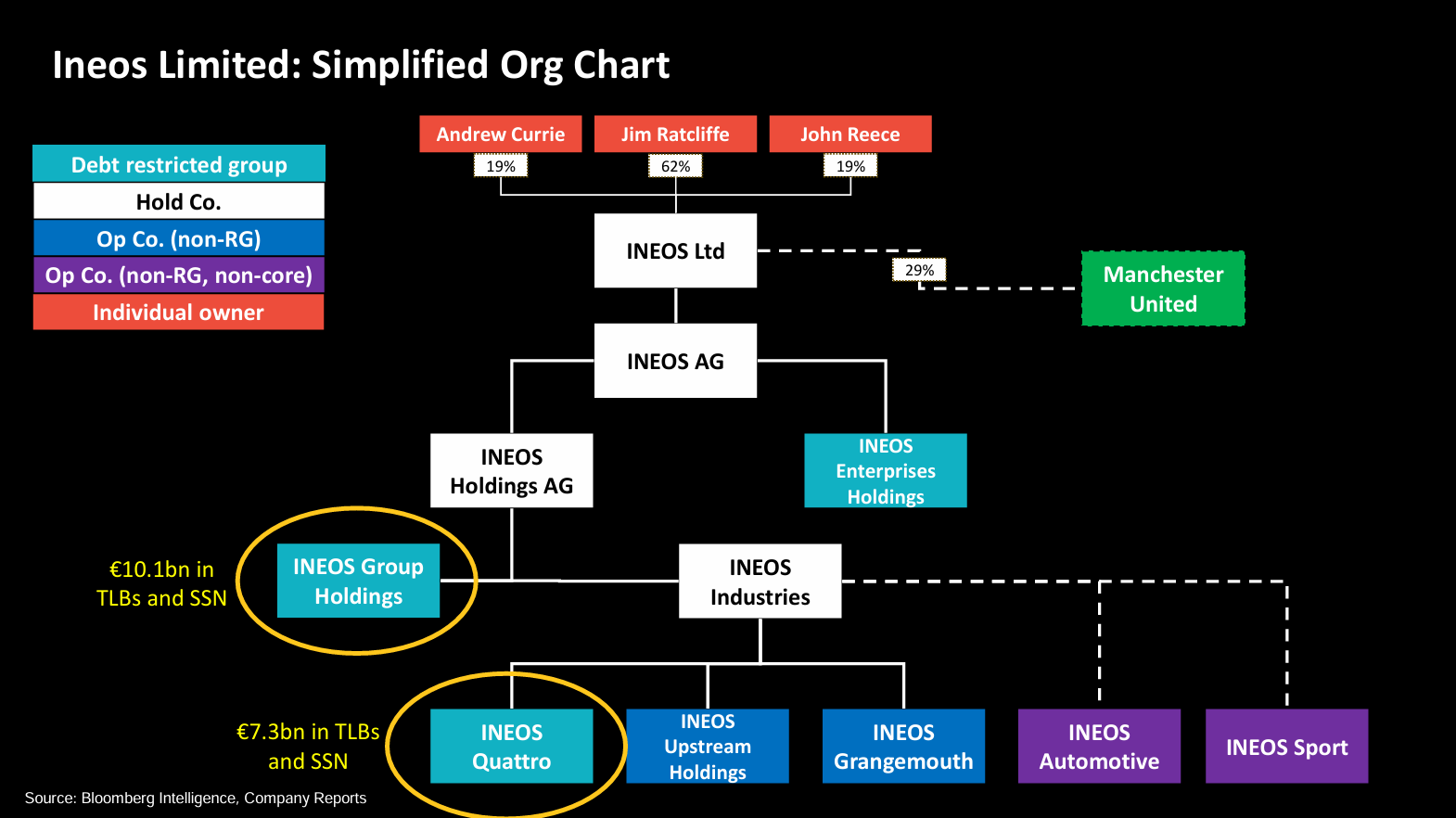
The INEOS empire is a privately-held global petrochemicals conglomerate ultimately owned by British billionaire Sir James (Jim) Ratcliffe (approximately 60% ownership), with the remaining stakes held by co-founders John Reece and Andrew Currie (approximately 19% each).
Corporate Structure Hierarchy
At the apex sits INEOS Limited, which owns all subsidiaries through INEOS Holdings. Below this ultimate parent, the empire has evolved into a complex web of operating entities and financing structures that can be divided into several distinct perimeters:
The Two Main Debt-Issuing Perimeters
1. INEOS Group Holdings (INEGRP) - The Crown Jewels
Focus: Olefins & Polymers (ethylene, polyethylene, polypropylene) and Chemical Intermediates
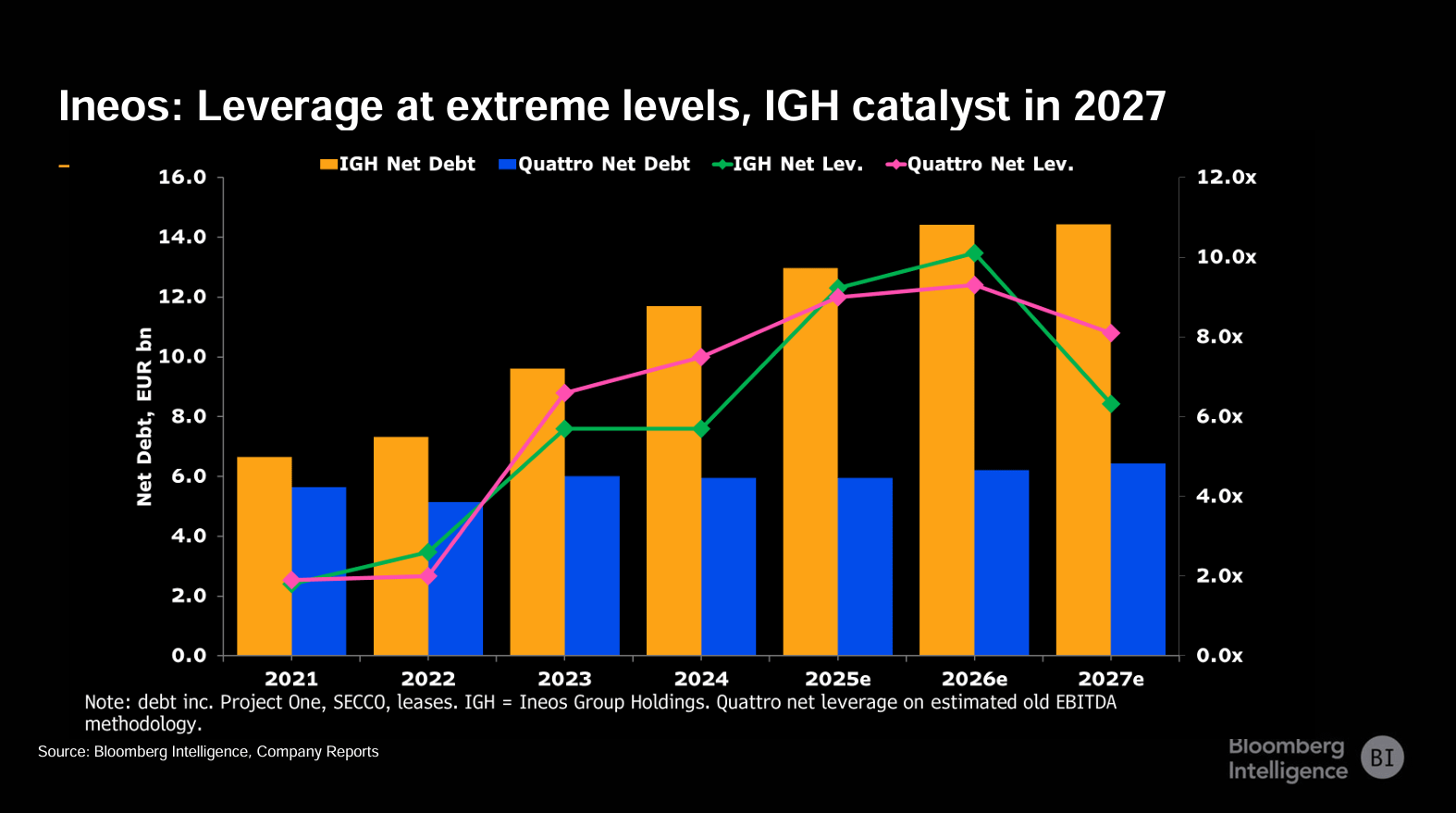
Debt: Approximately €13 billion net debt as of year-end 2023, up from €7 billion in 2021
Leverage: 9x net leverage (as of 2025), well above the internal 3x target
Geographic split: 52% Europe, 35% North America, 9% Asia
Capacity: ~24 million tonnes currently, expanding to ~33.5 million tonnes by 2026
Key assets: Cost-advantaged positions in US and Europe, including the Rafnes cracker in Norway
2. INEOS Quattro (STYRO) - The Challenger
Focus: Styrenics (Styrolution), PVC (INOVYN), Aromatics, and Acetyls
Formation: Created in 2020 through acquisition of BP’s aromatics and acetyls assets
Debt: Approximately €6 billion, relatively stable
Leverage: 8x net leverage (as of 2025)
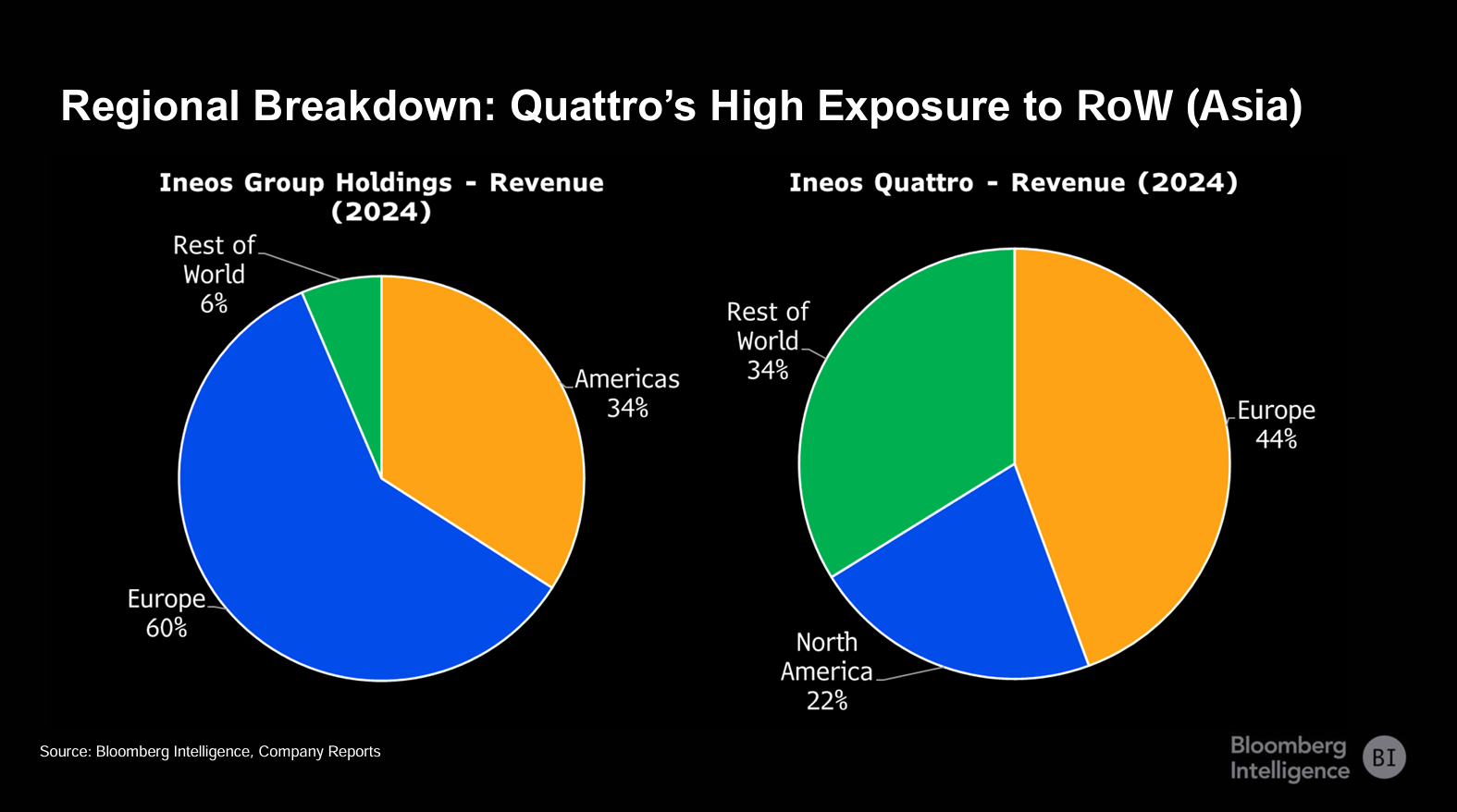
Geographic split: Higher Asia exposure (~33% of revenues) than INEGRP
Challenge: More cyclical earnings, lacks clear deleveraging catalyst
Beyond the Bond Perimeters: The Wider Empire
The INEOS family extends well beyond these two restricted credit groups:
Oil & Gas Assets (INEOS Energy)
Significant North Sea presence (original business)
Heavy US investment in recent years
Generated ~€600 million EBITDA in 2024
Other Chemical Assets
INEOS Grangemouth (UK refining/petrochemicals) - outside bond groups
INEOS Enterprises - formerly a debt-issuing entity, redeemed last loan in 2025
INEOS China Holdings - unrestricted subsidiaries with 50% stakes in SECCO and Tianjin Nangang Ethylene Project partnerships with Sinopec
Automotive Division (INEOS Automotive)
Sold approximately 8,000 vehicles in the US in 2024 (60-70% of total sales)
Generated negative €30 million EBITDA - a cash drain
Sports & Entertainment Holdings
~29% stake in Manchester United FC (acquired by Sir Jim Ratcliffe personally, moved into group structure)
~33% stake in Mercedes Formula 1 team
Cycling teams, sailing ventures (INEOS Britannia), rugby sponsorships
INEOS Group Holdings: All hinges on Project One
INEOS Group Holdings operates as a ring-fenced restricted group with €13 billion in senior secured term loans and notes. Creditor recourse is limited to assets within this perimeter—the olefins and polyolefins value chain, plus chemical intermediates.
Restricted Group Assets:
O&P North America: US Gulf Coast ethylene crackers, polyethylene units; ~50% of EBITDA
O&P Europe: Cologne (Germany), Rafnes (Norway), soon Project One (Belgium)
Chemical Intermediates: Nitriles, oligomers, oxide, phenol businesses
Business Overview
INEOS Group Holdings is one of Europe’s largest petrochemical producers, operating 39 manufacturing sites across nine countries through three segments:
Olefins & Polymers Europe (28% of capacity, 38% future EBITDA): Integrated crackers in Cologne and Rafnes producing ethylene, propylene, polyethylene, and polypropylene. Post-Project One, this becomes the dominant segment.
Olefins & Polymers North America (21% capacity, 30% future EBITDA): Cost-advantaged facilities in Chocolate Bayou (Texas) and Canada with access to cheap ethane feedstock. Historically INEOS’s most profitable segment.
Chemical Intermediates (44% capacity, 26% future EBITDA): Phenol, acetone, acrylonitrile, ethylene oxide, and specialty products serving automotive, construction, and industrial end markets.
Market positions: #1 globally in phenol, acetone, and acrylonitrile; #1 in Western Europe for ethylene and polyethylene; top 3-8 positions in North American olefins/polymers.
The business is highly cyclical and commodity-exposed, with 44% of sales to packaging (27%) and construction (17%)—both GDP-sensitive sectors that have been weak throughout 2023-25.
Geographic Split:
United States: >50% of EBITDA
Europe: ~40%
Asia: <10%
US producers operate ethane-based crackers at ~$280/ton cash cost for ethylene versus European naphtha-based production is structurally higher cost at €870-950/ton due to feedstock disadvantage. INEOS Group Holdings' limited Asia exposure (<10% of revenues) is a structural advantage, insulating it from the region's compressed margins and oversupply dynamics.
End-Market Exposure:
Packaging: ~27%
Construction: ~17%
Consumer goods: ~12%
Transportation (automotive): ~9%
Industrial: balance
Packaging and construction together represent 44% of sales—both GDP-sensitive sectors weak throughout 2023-25.
Financial Profile: Leverage at Distressed Levels
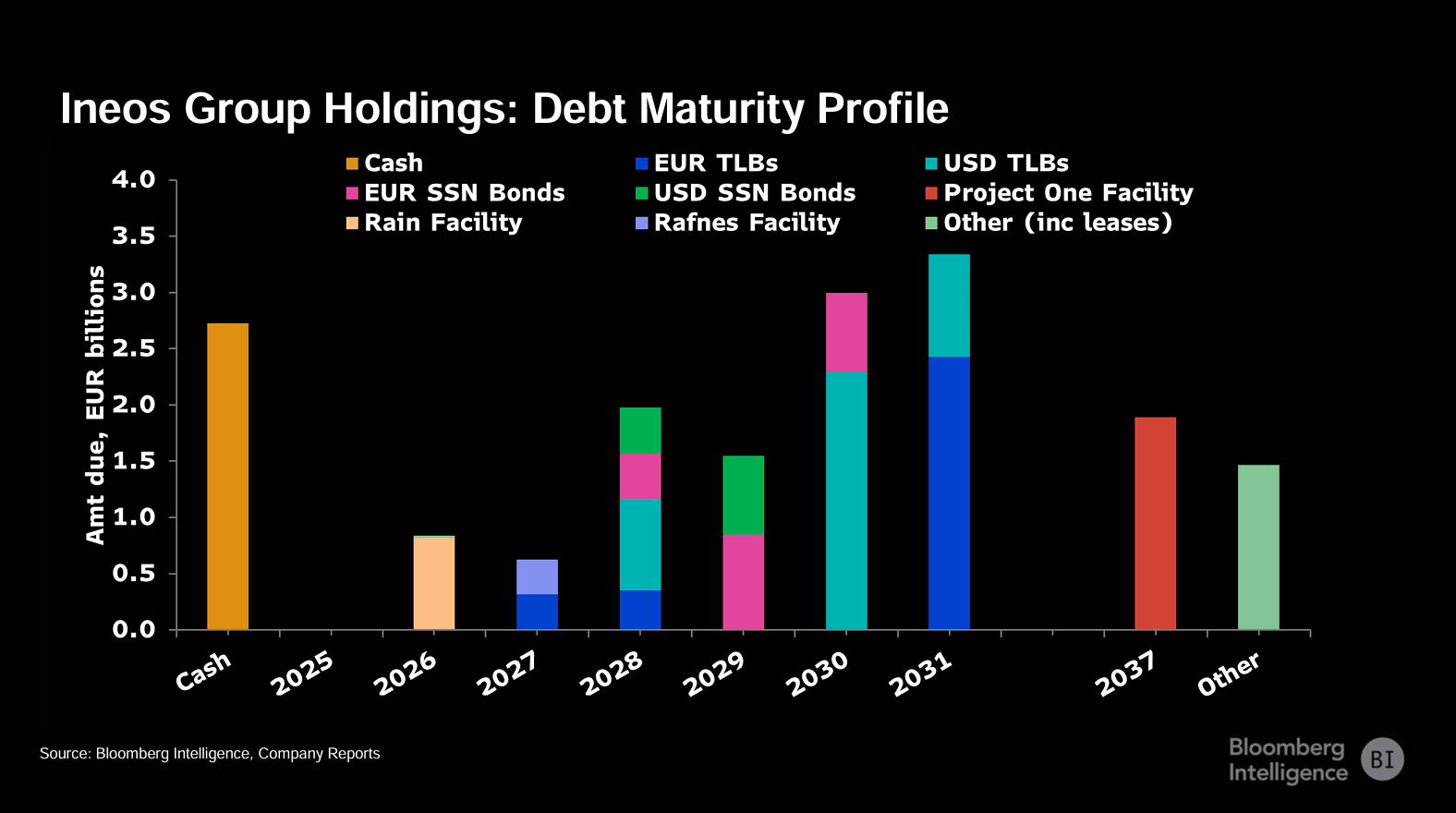
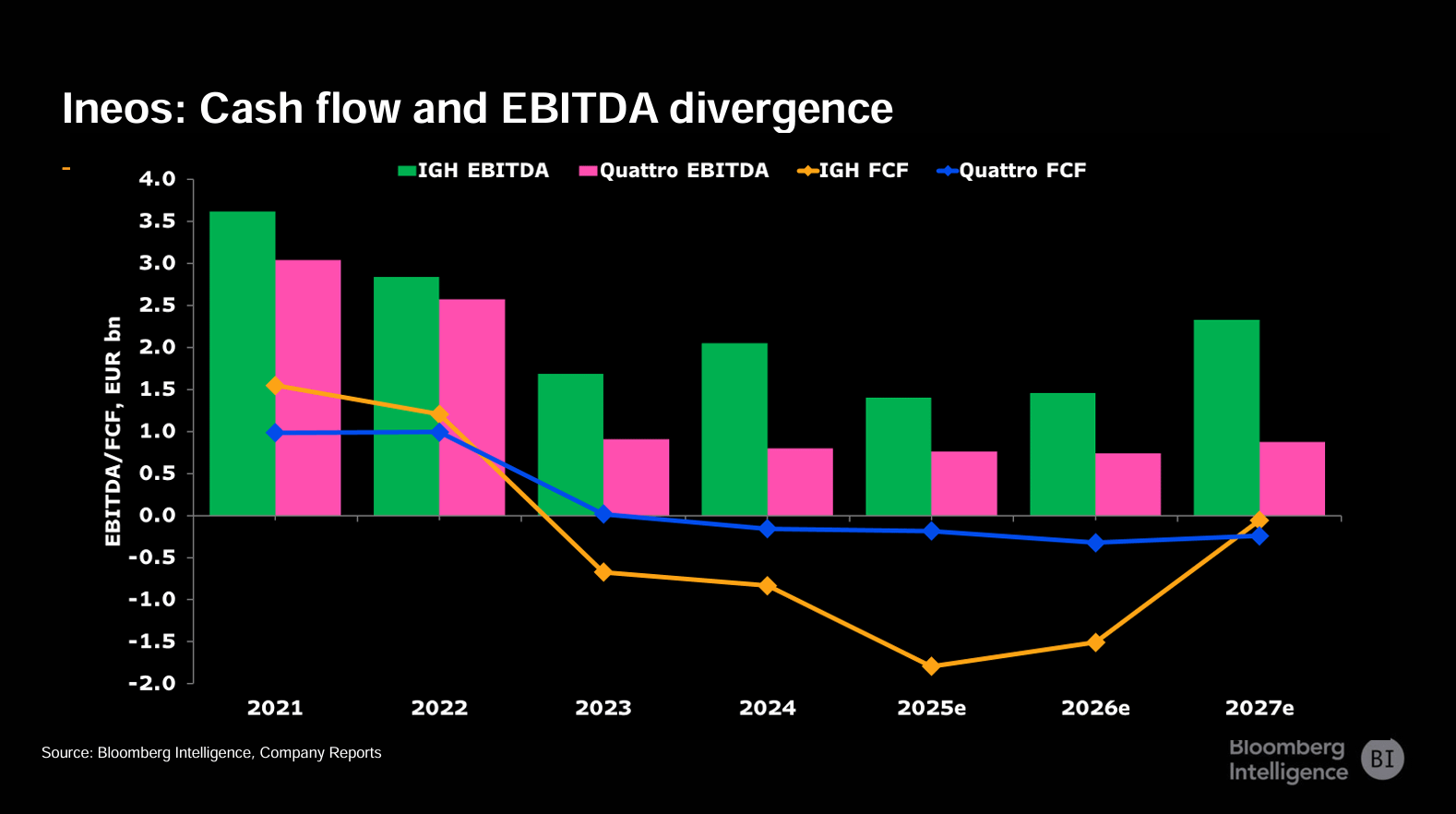
INEOS Group Holdings has transitioned from FCF positive pre-2023 to heavy cash burn driven by Project One capex. Excluding Project One costs, the core business remains cash generative even in this deep trough.
The impact of Project can be seen in that the company burned €579mm in a single quarter in 1Q25 despite generating €416mm EBITDA—Project One capex (€1.8bn annually through YE26) and seasonal working capital consumed all cash generation. At current run rates with EBITDA remaining at trough and Project One capex continuing, leverage trends toward 9-10x by YE25.
Current Metrics
Net debt: €11.3bn
LTM EBITDA: €1.5bn (annualized from 9M25, deep trough cycle)
Net leverage: 7.9x (vs. 1.6x at YE21, management target <3x) / 10.3x pension adj.
Putting it into Context:
Estimated mid-cycle EBITDA: €2.7bn (pre-Project One)
Post-Project One mid-cycle EBITDA: €3.6-3.9bn (management guidance)
The delta between currently €1.4bn actual and €2.7bn mid-cycle reflects commodity chemical cyclicality: 4-6 percentage points of utilization decline destroys 40% of EBITDA when feedstock costs remain sticky and fixed costs (~10% of total) cannot flex.
Capital Structure
€13.0bn total debt (Sep 2025): €3.9bn structurally senior (30%, project finance), €7.1bn senior secured loans (55%, SOFR/EURIBOR+3-3.5%, 2028-31), €3.75bn NY law senior secured bonds (29%, 5.6-7.25%, 2028-31). Net debt €11.3bn vs LTM EBITDA €1.46bn = 7.8x leverage (10-year high, management target <3x). Peak 9x projected YE25 per rating agencies. €3.2bn liquidity (€2.6bn cash + €0.6bn facilities) covers 2025-26 FCF burn. Weak covenants permit €4.2bn additional debt (2.5x EBITDA) + €1.8bn general basket + pick-your-poison conversion of RP capacity.
Legal considerations
INEOS Finance PLC (UK SPV) issued €3.75bn New York law senior secured bonds guaranteed by INEOS Group Holdings SA (Luxembourg parent) and 50+ operating subsidiaries. An English law Intercreditor Agreement (ICA) governs lien priorities, establishing pari-passu ranking with €6.7bn Senior Facility Agreement (SFA) term loans and existing SSNs. Structurally senior debt (€3.9bn) at Rain China JV, Rafnes Norway, and Project One sits outside creditor reach. French/German collateral liens rank locally junior but contractually pari via ICA. 90% lender consent required for major collateral/guarantor releases; non-ICA parties (unsecured creditors) bypass standstill/turnover protections. Non-core assets (O&G, automotive, sports) reside above restricted group at Ratcliffe holdco.
Structurally Senior:     €3.9bn (30%)  → Project finance (non-recourse)
Senior Secured Loans:    €7.1bn (55%)  → SOFR/EURIBOR+3-3.5% (2028-31)
**NY Law SS Bonds:       €3.75bn (29%)** → 5.6-7.25% (2028-31)

**Upcoming Maturities:**
• **2027**: €375m Term Loan (Oct 2027)
• **2028**: €2.0bn (SSN 28s + TLs)
• **2029-31**: Bulk of €10bn stack
Current public ratings for INEOS Group Holdings (IGH) are:
Moody’s: B2, Outlook Negative (downgraded from Ba3 in 2025)
S&P: BB–, Outlook Negative (affirmed on IGH / group; leverage concerns)
Fitch: BB–, Outlook Negative (downgrade Sept 2025; senior secured rated BB+ / RR2)
Project One: Quantifying the Catalyst
Project One is a €4.8bn ethane cracker in Antwerp, Belgium, ~70% complete as of 4Q25, targeting mechanical completion YE26 with commercial operations 1Q27.
Capacity and Economics:
Annual ethylene production: 1.5mm tons
Feedstock: US ethane imported via ship
European ethylene price: ~€1,200/ton (current depressed environment)
Total cash cost: ~€480/ton (ethane €280 + shipping €50 + operating €150)
Margin per ton: €720
Annual EBITDA: €1.08bn at current depressed prices
Management guides to €700mm “even in H2 2025-like environment,” recently updated from €600mm. The margin is derives from the permanent feedstock differential between US ethane and European naphtha.
Stress Testing the Economics:
At €900/ton ethylene (severe downturn):
Project One margin: €420/ton
European naphtha-based margin: breakeven to negative
At €1,400/ton ethylene (mid-cycle):
Project One margin: €920/ton
European naphtha-based margin: €450-530/ton
Project One sits in the first quartile of the European cost curve regardless of market conditions.
Operational Precedent: Rafnes
INEOS already operates an ethane import model at Rafnes, Norway:
Built late 1970s, smaller scale than Project One
Ships US ethane, cracks locally, sells into Europe
Generated €200-250mm annual EBITDA at 100% utilization throughout the 2022-25 downcycle
Only cracker in Europe that maintained full utilization while peers idled capacity
Rafnes proves the model works. Project One replicates this at 1.5x the scale with modern efficiency.
Structural Issues at INEOS Group holdings
€3.9bn Structurally Senior Debt
These asset sit inside the restricted group, but are structurally senior because they’re ring-fenced with asset-specific security packages:
Project One: €3.5bn facility (of which €2.49bn drawn (secured by Antwerp assets))
Rafnes: €500mn (secured by Norwegian cracker, amortizing)
Rain/China JVs: €545mn (secured by SECCO/Tianjin stakes, non-recourse)
Inventory financing: €260mn (secured by working capital)
Other: €70mn
Total €3.9bn ranks ahead of €10.1bn “senior secured” bonds/TLBs—these lenders have first liens on revenue-generating assets while IGH bondholders have only share pledges.
Project One: €4.8bn Cracker Investment
Europe’s first new ethane cracker in 20+ years (Antwerp, Belgium), financed via €3.5bn project debt at INEOS Olefins Belgium NV plus ~€1.5bn equity from IGH parent. The €3.5bn Project One facility has first-ranking liens on the actual cracker assets. IGH bondholders only hold share pledges over the subsidiary—they receive residual equity value after €3.5bn project lenders are paid.
Related-Party Loans: €1.65bn Disguised Equity
€1.65bn unsecured loans to INEOS family entities, repeatedly extended, should be accounted rather as equity than debt:
€1.34bn to INEOS Upstream/Energy (US oil & gas): Originally due 2023-24, now 2028-29
€309mn to Grangemouth (UK refinery): Due Jan-28
Both entities are loss-making (Grangemouth: high UK energy costs; US shale: marginal in low oil prices). Management pushed repayment from 2H23→2024→2025→”maybe 2026”→now 2028-29. These are permanent value leakage from the restricted group.
Value Leakage Risks due to weak documentation
The covenant documentation leaves bondholders exposed to multiple liability management tactics that could significantly reduce recovery:
Senior debt layering: €4.2 billion (2.5x EBITDA) capacity for pari passu senior secured debt, plus equal capacity for structurally senior non-guarantor debt. The 3x leverage ratio is not a cap—INEOS can add debt up to 3x, then layer more through other baskets.
“Back door dividend”: €5.2 billion (3.1x EBITDA) Unrestricted Subsidiary capacity allows INEOS to transfer assets into an UnSub, then distribute the UnSub equity to shareholders—leaving bondholders with a hollowed-out restricted group.
Asset stripping: 540-day asset sale reinvestment period extends indefinitely via “binding commitments.” Asset sales funding Restricted Payments are excluded from the covenant entirely.
Affiliate payments: €328 million annually for “any other amounts” plus €191 million for management fees—potentially €1.3 billion over the notes’ life.
Historical precedent: INEOS granted €1.1 billion in related-party loans in 2023, with repayment delayed to 2025-2028.
Thinking about valuation
This analysis presents factual observations only and constitutes neither investment advice nor a recommendation. Bond prices as of Jan 18, 2026: 2031s ~81¢, 2028s ~90¢
Traditional relative value analysis—spreads/yields—becomes unreliable when leverage approaches 10x, covenants permit €4bn+ of incremental secured debt capacity, and €3.9bn structurally senior claims rank ahead of the restricted group. At this leverage inflection, liability management exercises (LME) become increasingly likely, thus requiring a distressed valuation framework: probability-weighted liquidation analysis.
INEOS Group Holdings controls high-quality assets with significant embedded optionality. Project One completion plus mid-cycle recovery could result in triple current enterprise value. Just by Project One coming online as expected and FCF recovery due to the high operating leverage embedded in the business. The table illustrates this dynamic: €1.5bn trough EBITDA scales to €3.6bn post-Project One at 6-8x multiples, producing 2.5-3x debt coverage. Petrochemical peers (LYB, DOW, WLK) consistently trade 6.5-9x mid-cycle EBITDA; trough multiples compress to 5-7x.

However, 2026 leverage remains elevated. Final Project One capex (€1-2bn) can increase net debt/EBITDA >9-10x. Leverage normalization in 2027 to 4-5x would require Project One FCF plus equity contributions from Ratcliffe—uncertain given the opaque financing structure.
The controlling variable is LME execution—a binary outcome that dominates whether bondholders can benefit from the Project One coming online and the operational recovery. Various research firms argue, that the documentation permits up to 8bn in incremental senior secured capacity. In addition, there is capacity for up to €5.2bn unrestricted subsidiary transfers and the additional potential for a sale to a related party.
Listen to the full episode for Tim’s take on INEOS.
This article is based on Episode 5 of Fixed + Floating, featuring Timothy Riminton of Bloomberg Intelligence. The views expressed are those of the speakers and do not constitute investment advice. For more information on Tim’s research, Bloomberg Intelligence clients can reach him via IB (Timothy Riminton BIO on the Bloomberg Terminal).
Fixed + Floating is the premier podcast for institutional investors and finance professionals exploring the forces shaping global credit markets. Hosted by Portfolio Manager Josef Pschorn, the show features conversations with leading voices from investing, research, and academia. We analyze the technical mechanics of High Yield, Private Debt, and Distressed Situations—from covenant evolution and liability management to macro policy impacts on credit cycles—providing forensic depth for the global fixed-income community.
Support Material:

The €700mm EBITDA from Project One is compeling here, especially when you consider it's basically locked in by the feedstock arbitrage between US ethane and European naphtha. Rafnes operating at 100% utilization through the downcycle is proof that cost position matters more than demand environment. That ethane advantge is structural, not cyclical.