


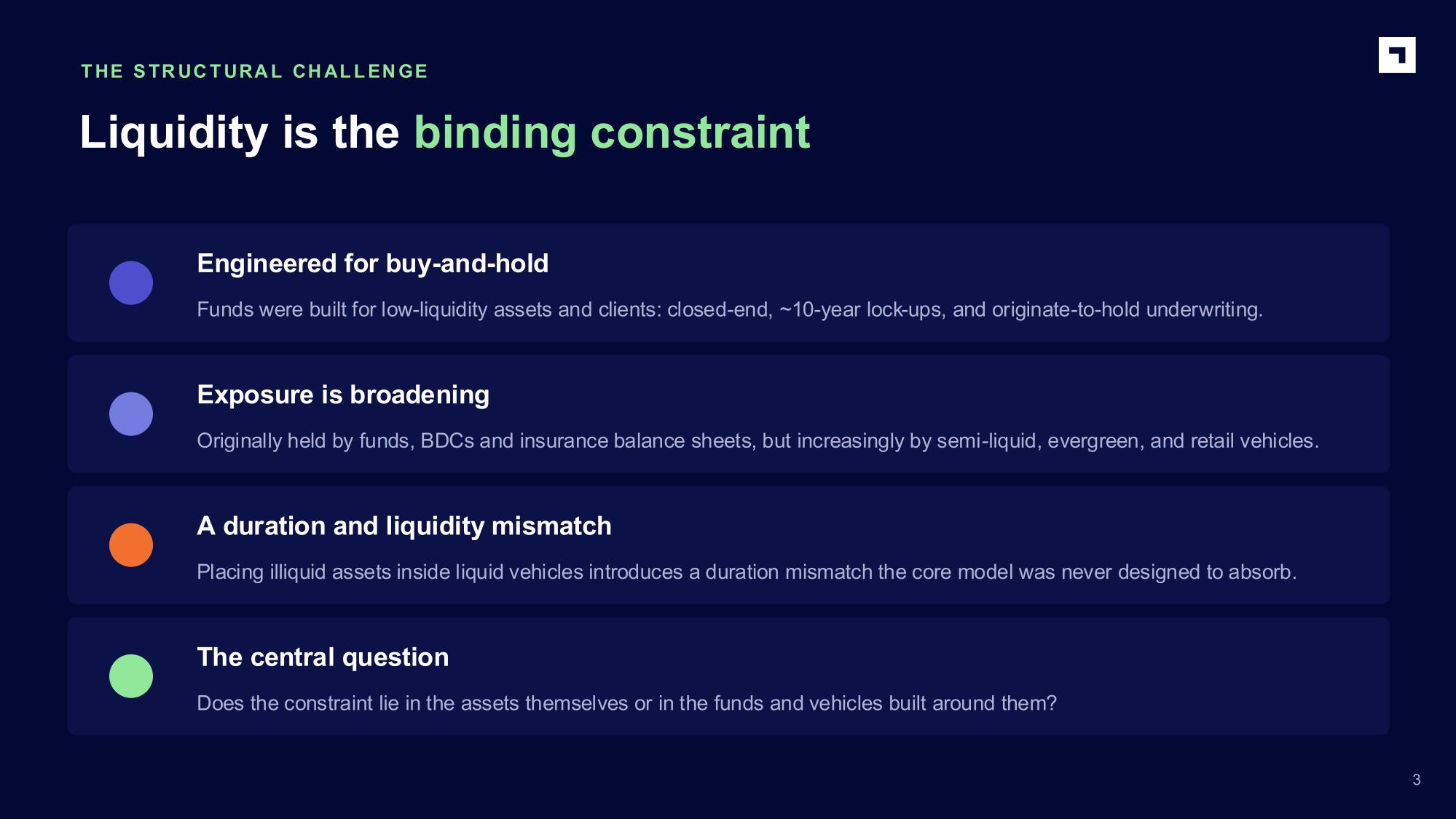
Private credit is a roughly $2 trillion asset class that still transacts like a series of bilateral favors. The redemption queues at Blue Owl, Apollo and other semi-liquid vehicles have forced allocators to confront a mechanical reality the fundraising decade ignored: a $25 million loan takes four to six weeks to change hands, assuming a buyer exists at all. The constraint does not sit in the loans; it sits in the vehicles built around them.
Everything that follows concerns the US market. The vehicles are American constructs — BDCs, interval funds, evergreen wrappers — and so is the transfer machinery: NY-law credit agreements, LSTA forms, ClearPar. European private credit shares the direction of travel but runs on different documentation and different regulation; it deserves its own note.
The vehicles outgrew the assets
Private credit grew out of the post-2008 retreat of bank lending. Non-bank lenders filled the gap banks left behind, helped by the first fintech wave, which changed how consumer and small-business assets were originated. The capital came from ten-year, closed-end funds, and the LPs were pension funds and endowments with long horizons and stable liquidity needs.
That architecture contained no duration mismatch. A ten-year fund holds a five- or six-year loan comfortably inside its own life; fund lifetimes and asset lifetimes were aligned by design, and the asset class’s buy-and-hold culture grew out of that alignment. Nobody built transfer infrastructure because nobody needed to transfer anything.
The 2020s changed the liability side. BDCs, interval funds and evergreen structures brought private credit to high-net-worth and retail investors — the funds are now available through Schwab and Fidelity — and even long-dated institutional vehicles have drifted toward evergreen formats. A five-year, originate-to-hold asset now sits inside a wrapper promising quarterly liquidity, held by an investor whose liquidity profile resembles nothing the original model was designed for. The end point of the wrapper logic arrived in 2025 with the State Street–Apollo PRIV ETF, which places up to 35% private credit inside a daily-liquidity ETF, supported by Apollo’s commitment to bid on the fund’s private positions — up to a daily limit the filings do not define.
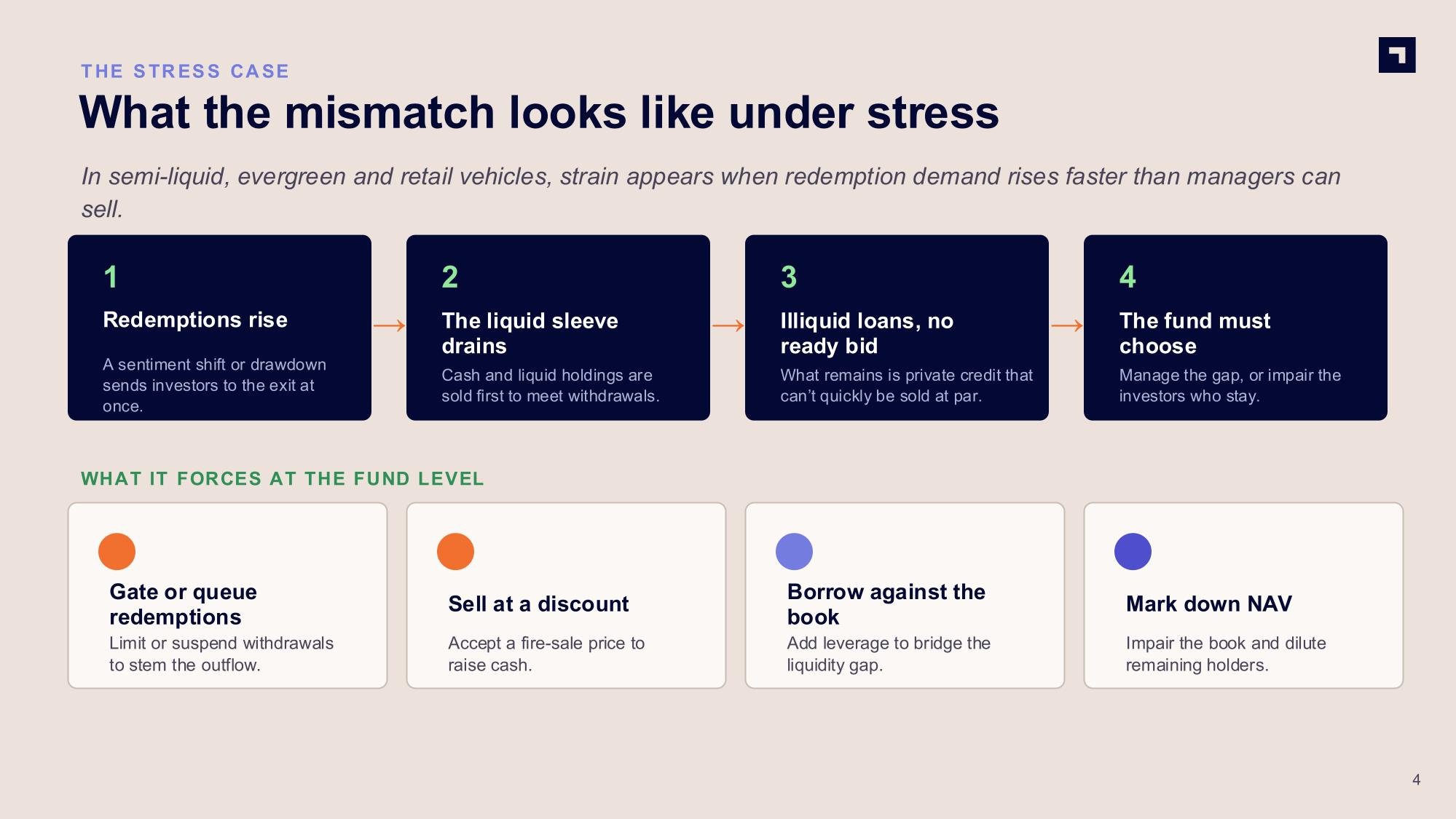
Under stress the sequence is fixed. Redemptions rise; the liquid sleeve is sold first; what remains is private credit with no ready bid. The vehicle then gates withdrawals, sells at a fire-sale discount, borrows against the book, or marks down NAV and dilutes the holders who stay. Forced sellers are created on a schedule that has nothing to do with borrower performance — vehicle-design risk sits in front of asset risk.
The first half of 2026 supplied the numbers. Blackstone’s $82.5 billion BCRED received $3.8 billion of redemption requests in the first quarter — 7.9% of assets. Blue Owl’s OCIC faced requests on 21.9% of its shares in the same period; non-traded BDCs as a group ran at roughly 12%. (Partners Group gated an evergreen vehicle in June — a European manager, and the one non-US data point here; the pattern travels.) The gates are doing what they were built to do. What their use signals is the harder point: vehicles whose stated liquidity terms exceed what the assets can fund.
No infrastructure below the syndicated market
Corporate bonds settle through CUSIPs, broker-dealers and clearing houses. Broadly syndicated loans run through agent banks with established transfer mechanics. CLOs and securitisations carry their own plumbing. Below that, in true private credit — the bilateral loan between a private lender and a private borrower — the infrastructure stops.
There is no clearing house for these loans and no CUSIP equivalent. No central record of who holds what exists; the documents sit with the parties. Selling a position means partners working their personal networks, deal by deal:
“There is no formalized capital market. You’ve got your partners and your other investment professionals essentially doing roadshows every time they want to sell a deal — going to folks that they know and essentially saying, ‘Hey, do you wanna buy some of this private loan?’” — Alex Cordover, CEO, Tradable
Twenty years of non-bank lending built origination capability without transactional muscle memory. Positions trade anyway — club deals, quiet syndications, transfers between friendly firms — but unadvertised, because a market raised on buy-and-hold treats visible selling as a confession. The volume that exists is the market everybody uses and nobody discusses.
Anatomy of a $25 million transfer
The first decision is structural, and it is binary. An assignment is a true sale: the schedule of lenders changes, borrower consent is usually required, the credit agreement may be amended, and the buyer becomes lender of record. A participation moves the economics only: the seller remains lender of record, keeps the borrower relationship, and typically charges a fee for the arrangement. A sub-participation — a participation written on a participation — adds a further layer between the holder and the claim.
The second decision is the counterparty universe. Sellers exclude direct competitors — the firms they meet in fundraising — before showing anything. Distribution then runs through the seller’s own network, through a bank or broker at significant fee cost, or through a formalised venue.
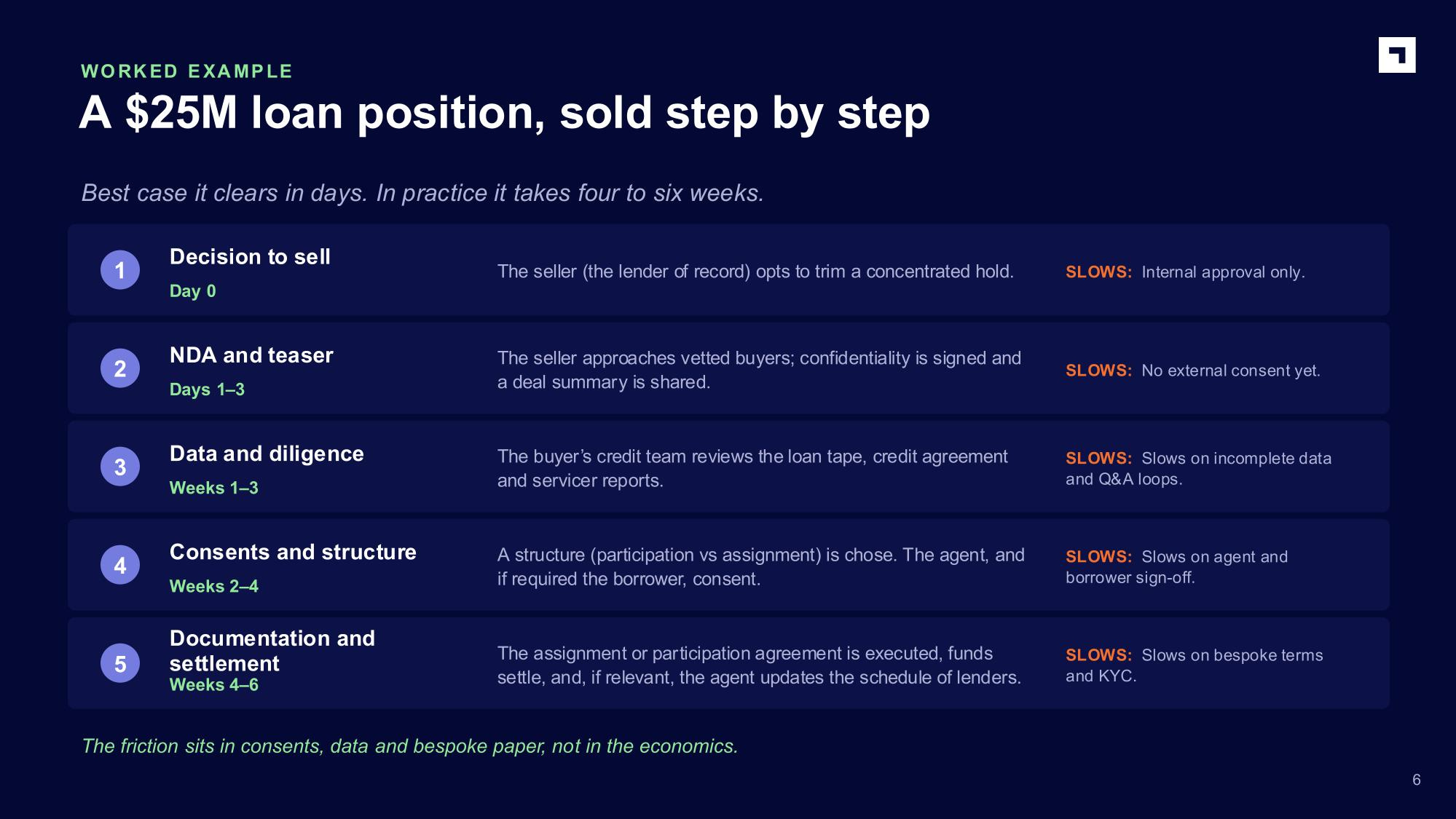
The process itself: NDA and anonymised teaser; data room containing the loan tape, company financials and, in most secondary sales, the seller’s original investment committee memo; full re-underwriting by the buyer (a stage AI is compressing from weeks to days, with buy-side teams loading data rooms directly into language models); non-binding indication of interest; consents; documentation; settlement. Non-circumvent clauses are fought over in every NDA — sellers fear a buyer walking around them to refinance the borrower directly — but in practice buyers meet the borrower during diligence, and outright circumvention is rare because it is reputationally terminal in a market this small.
The four to six weeks decompose as follows: roughly a week to get under NDA, two weeks of building competitive tension, two to three weeks of diligence, then negotiation through two investment committees. AML, KYC and closing paper move quickly when the credit agreement is untouched. A secondary clears faster than a primary for one reason — the covenants exist, the covenant testing runs, and the borrower already produces the reporting package. Nothing is invented, only transferred.
The paper itself
An assignment does not create a new credit agreement. The buyer accedes to the existing documents through an Assignment and Assumption — a short-form exhibit, standardised by the LSTA, attached to most NY-law credit agreements — and the agent updates the register, the definitive record of who is lender of record. The register, not the credit agreement, answers the question of who holds the loan; the underlying documents themselves sit with the parties. Broadly syndicated loans settle this electronically through ClearPar. Private credit has no equivalent — settlement is email, signature pages and wires.
The consent architecture is where transfers are actually won or lost. In syndicated-style documents, borrower consent to an assignment typically cannot be “unreasonably withheld,” is deemed given if the borrower does not object within five to ten business days, and falls away entirely after an event of default. Private credit documentation is materially tighter. Sponsor-negotiated agreements increasingly carry language making it expressly not unreasonable to refuse distressed-debt or special-situations buyers, and disqualified lender lists — borrower-designated entities barred from ever holding the debt — have expanded in scope: competitor lists updated post-closing, whole categories of institutions excluded, and, in aggressive documents, DQ provisions that survive a default. Whether a DQ list falls away when the borrower stops performing is one of the most consequential and least-read provisions in the document.
This consent asymmetry is the real reason participations exist. A participation requires no borrower consent and does not touch the register — it is the workaround for exactly the loans whose documents make assignment impractical. The price of the workaround is the rights position described below.
Holder structure changes the mechanics again. In a single-lender bilateral loan, the lender is also the agent: selling the position means replacing the counterparty the sponsor originally chose, agency functions must transfer or be re-papered, and consent is a genuine negotiation rather than a procedural step. In a club of two to five lenders, agency and pro-rata mechanics already exist and the consent circle is small. Larger syndicated-style unitranches — with a register, assignment exhibits and minimum transfer amounts — are structurally closest to the BSL market, which is why they trade first. The more the paper already resembles syndicated documentation, the shorter the distance to a functioning secondary.
Structure decides the workout
Structure diligence precedes credit diligence. The transfer mechanism chosen on day one defines where the legal claim sits on the day the credit breaks:
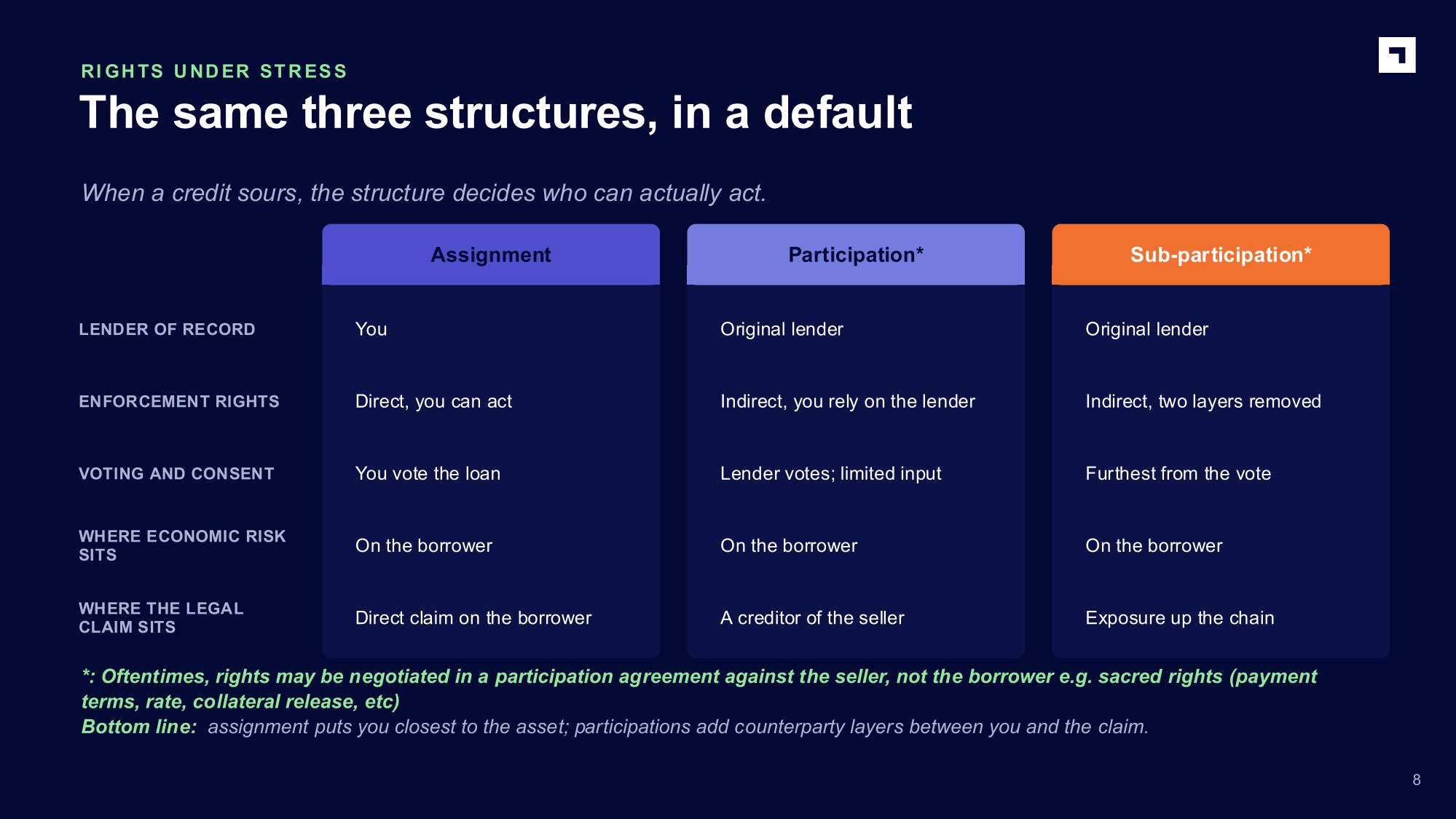
In an assignment, the buyer holds a direct legal claim on the borrower: voting, enforcement, the ability to call events of default. In a participation, the buyer holds a bilateral exposure to the seller. Sacred rights — payment terms, rate, collateral release — can be negotiated into the participation agreement, but they are rights against the counterparty, not the company. A participation holder without explicitly negotiated rights has no seat at the restructuring table.
Enforcement capacity splits by collateral type. Asset-backed lenders operate two decades of machinery — bankruptcy-remote SPVs, borrowing bases, backup servicers — and step into collateral routinely. Direct lending is structurally messier: crowded capital stacks, senior through mezzanine, and collateral that is an operating business rather than a pool of receivables. The cleaner the logical separation of collateral, the more transferable the position.
Where trades die
Trades rarely die on asset quality; a buyer exists for everything at a clearing price. They die in two other places.
The first is the information-asymmetry prior. In a buy-and-hold market, any seller is presumed informed: why is this for sale, what does the seller know. Because selling is rare, selling is a signal; because selling is a signal, selling stays hidden; because selling stays hidden, it stays rare. Concentration limits, deal upsizing and vehicle liquidity needs are routine, legitimate reasons to sell — the market has not yet learned to read them as routine.
The second is agent mechanics. LPs spent decades deferring to a single GP by design; two GPs inside one deal is a newer and unresolved arrangement. A seller staying in a deal resists handing votes on defaults and covenant waivers to additional parties. A buyer resists holding economics while a competitor controls every decision that matters in a workout. No standard framework for shared agent functions exists, and until one does, this remains the largest single killer of otherwise agreed trades.
Marks meet bids
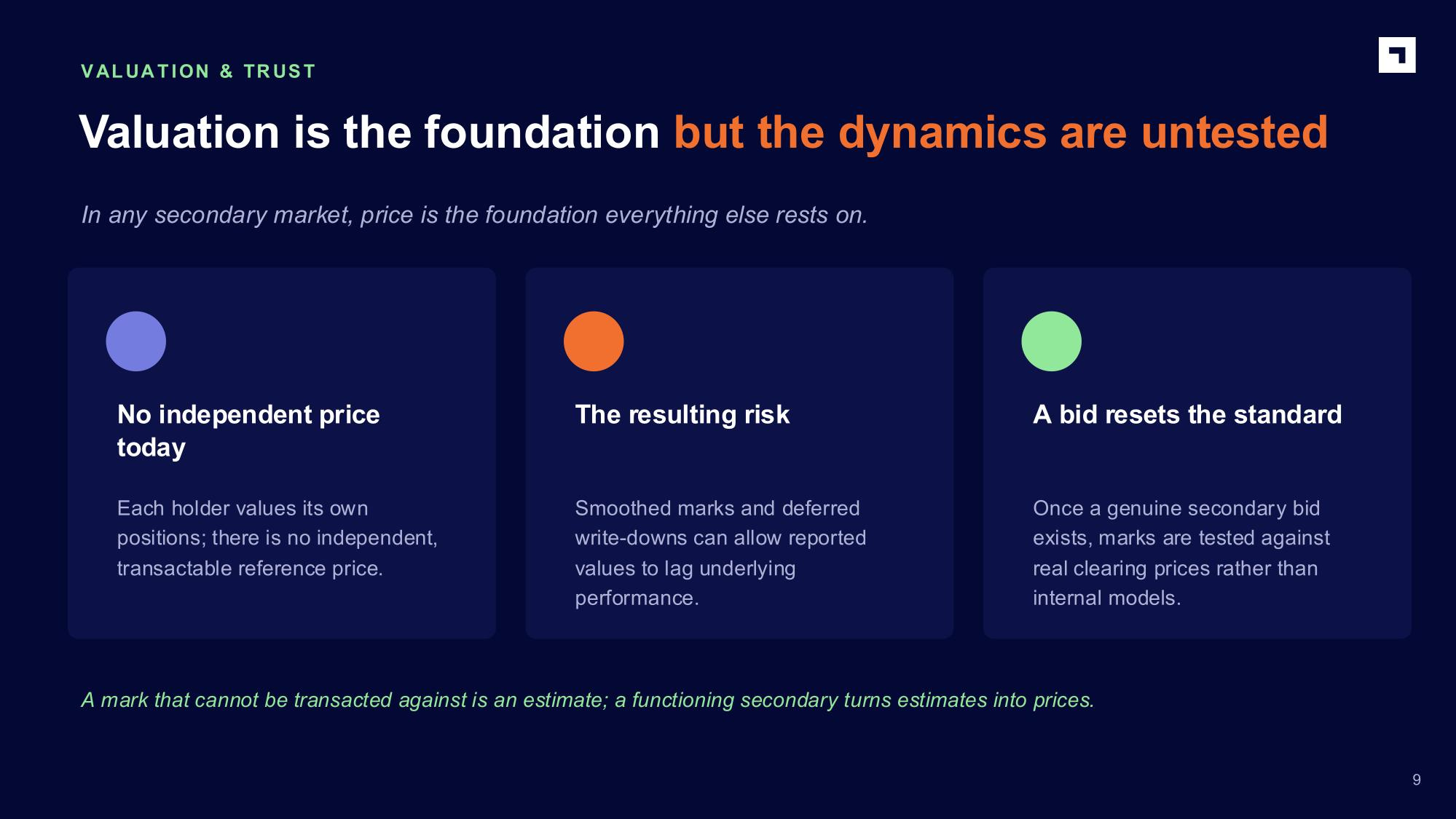
Private credit marks are set by the holder, reviewed by third-party valuation agents working from the holder’s own model inputs, and published on a quarterly cadence. No independent, transactable reference price exists. Every incentive in the chain rewards reported stability: smooth marks support the next fundraise and keep semi-liquid NAVs redeemable at par. The industry’s official term for the result is valuation lag; the blunter term in circulation among practitioners is “valuation laundering.”
Clearing prices are the only test, and the early evidence splits cleanly by segment. Per Tradable’s platform record — concentrated in asset-backed paper, where loan tapes, borrowing bases and collateral performance leave little room for managerial interpretation — every closed transaction has printed at par, usually plus a buyer’s premium. The selection effect cuts both ways: deals whose marks would not survive a bid tend to fail before closing, so the par prints coexist with books that have never been priced at all.
The wider secondary market prices the same question differently. Credit-secondaries volume roughly doubled in 2025 to about $20 billion (Evercore — a global figure, though the market is US-dominated), and pricing is bifurcated. GP-led transactions — continuation vehicles built on selected, performing assets — averaged around 98% of NAV, with TPG Twin Brook’s $3 billion vehicle printing at a slight premium. LP-led portfolio sales cleared near 91%. Par holds where the seller chooses the assets and the buyer re-underwrites them individually; whole portfolios, sold with the tails included, cost high single digits.
A public test also runs daily and is rarely cited in this debate. Listed BDCs trade at median discounts of roughly 15–25% to NAV, with individual names approaching 50%; FS KKR reported non-accruals of 4.2% at fair value in Q1 2026. Equity discounts embed leverage, fees and sentiment, so the read-through to asset marks is inexact. A persistent 20-point gap between exchange prices and reported NAV on the same asset class is, however, the market’s standing estimate of the lag.
Software direct lending is the untested book. Borrowers levered in 2021 saw debt service double as rates rose — $10 million of annual interest becoming $20 million removes $10 million a year from the business — while marks drifted down a few points a quarter. Asset prices do not change only when quarterly filings appear. A mark that cannot be transacted against is an estimate; a functioning secondary turns estimates into prices. Where marks have met real bids, they have held. Where bids are conspicuously absent, the silence is the signal.
Where liquidity forms first
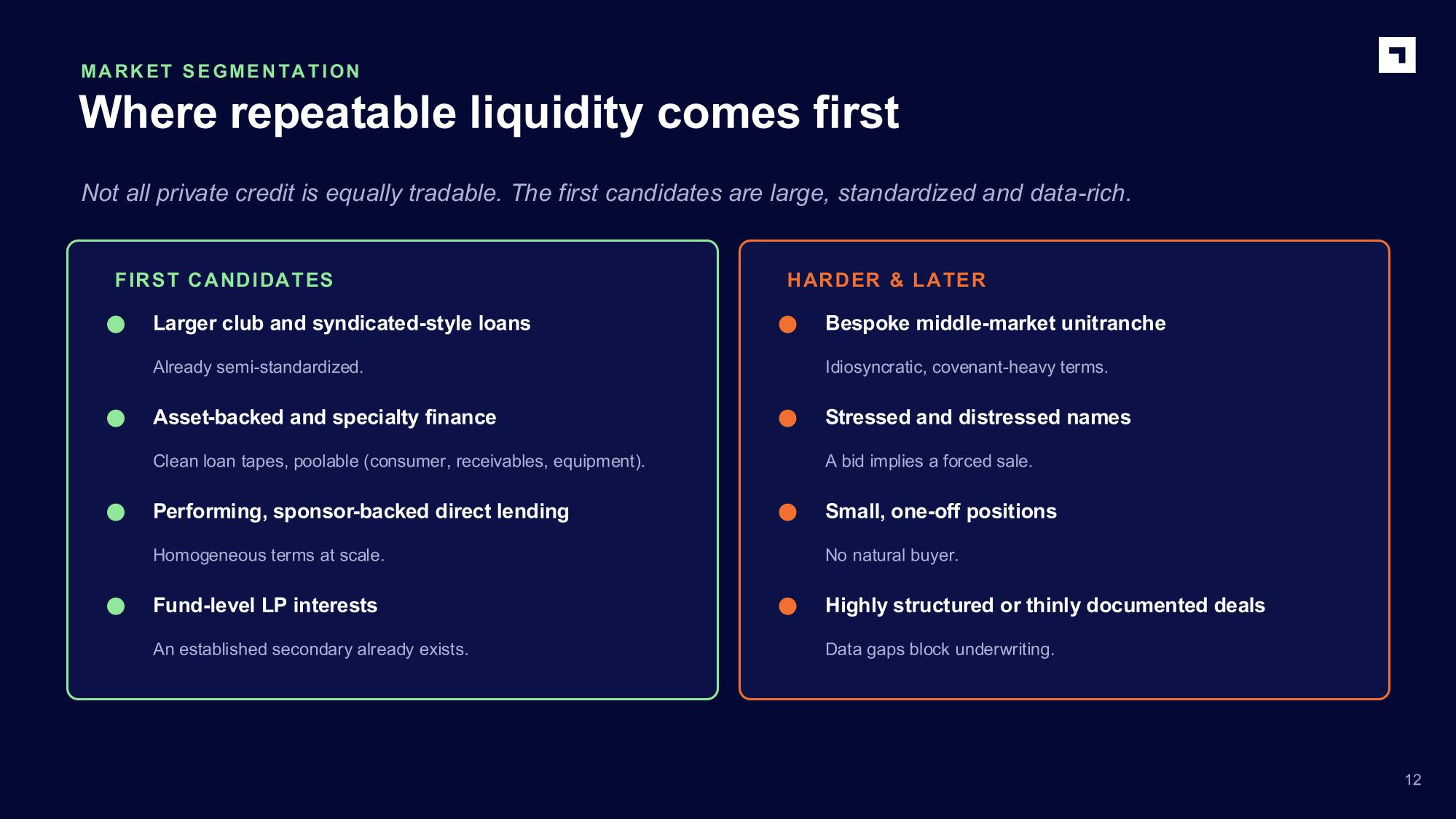
Not all private credit is equally tradable. Liquidity forms first where data is clean and terms repeat at scale: larger club and syndicated-style loans, asset-backed and specialty finance with poolable loan tapes, performing sponsor-backed direct lending, and fund-level LP interests, where a secondary market already operates. It arrives last where every position is a negotiation: bespoke middle-market unitranche, stressed names (a bid implies a forced sale), small one-off positions without a natural buyer, and thinly documented structures where data gaps block underwriting.
The buyer base is broader than the selling stigma suggests: credit funds and BDCs acquiring seasoned, performing paper faster than they could originate it; insurers and pensions deploying large tickets into duration-matched yield; dedicated secondary funds buying at discounts; banks optimising balance sheets; distressed buyers waiting for a clearing price. It is also no longer hypothetical. Dedicated credit-secondaries funds raised a record $16 billion in the first three quarters of 2025 — Ares closed $7.1 billion, Coller $6.8 billion, Pantheon above $5 billion.
The venue model is not the only infrastructure under construction. JPMorgan, Goldman Sachs, Bank of America, Morgan Stanley and Jefferies have begun making markets in private credit loans — circulating runs, quoting bid-ask on names such as Peraton — and Apollo has enlisted five banks to trade its paper. Early reports show more loans offered than bid for at current prices; sellers have arrived before buyers. Whether the market settles on dealer balance sheets or neutral venues remains open. That both are being built simultaneously is the strongest available evidence that the once-every-three-to-four-years cadence is ending.
The standardisation boundary is precise. Process, data and settlement can be standardised; covenants cannot, because the bespoke, bilateral nature of the paper is the product. The realistic end state is not a loan that trades ten times a day — no participant wants that — but a loan that can trade once a month instead of once every three to four years. Tokenization, stripped of its sales pitch, serves that end state in one specific way: co-locating the asset’s own logic — interest entitlement, principal balance, waterfall position, eligible-holder list — with the asset itself, on shared rails that replace bilateral firm-to-firm integrations. It is the DTCC and CUSIP function of the twentieth century, still vacant in this market.
What I take away for credit
1. Forced sellers are made by wrappers, not borrowers. The loans did not change; the vehicles did. Semi-liquid structures holding five-year assets against quarterly liquidity promises will keep producing liability-side stress independent of borrower performance. The screen runs on redemption terms against weighted asset maturity, before any credit work — and in a market without infrastructure, a forced seller often gets no price rather than a bad one.
2. Structure diligence precedes credit diligence. Four provisions dictate a loan’s true transferability: the borrower-consent standard, the scope and durability of the DQ list, the enforceability of sacred rights in a participation, and the mechanics of the agent register. All four are knowable before you do any credit work. Two loans with identical spreads and identical borrowers can have vastly different exit timelines and restructuring rights based entirely on these clauses alone. You must price the exit friction before you price the loan.
3. The absence of a bid is hard information. Asset-backed paper clears at par with buyers paying premiums; software direct lending prints nothing. Where marks can be tested against transactions, they have held; where they cannot, the book is carried at estimates. The first genuine prints in each untested segment will re-anchor entire books, in both directions. I will be watching where bids appear next — and where they conspicuously do not.
This article is based on Episode 17 of Fixed + Floating, featuring Alex Cordover of Tradable. The views expressed are those of the speakers and do not constitute investment advice. For more information, please visit tradable.xyz.
Fixed + Floating is the premier podcast for institutional investors and finance professionals exploring the forces shaping global credit markets. Hosted by Portfolio Manager Josef Pschorn, the show features conversations with leading voices from investing, research, and academia. We analyse the technical mechanics of High Yield, Private Debt, and Distressed Situations — from covenant evolution and liability management to macro policy impacts on credit cycles — providing forensic depth for the global fixed-income community.
Support Material:
