



In June 2020 Hertz was in Chapter 11. Its unsecured bonds were trading around 40 cents. Its shares still had a positive price.
The company asked the bankruptcy court for permission to sell new stock into that bid. It got permission on 12 June, placed roughly $29m, and pulled the offering within the week after the SEC said it would review the filing.
People bought that stock knowing the company was insolvent, and they were not necessarily wrong to. A Chapter 11 filing accelerates the debt, but it does not settle the claim on day one. The case runs for months. During those months the fleet gets remarketed, buyers appear, and the estate finds out what the assets are actually worth. Buying the equity in June 2020 was a bet that the business would recover enough inside the process to clear the debt. That is what happened. Used-vehicle prices rose through 2020 and 2021, the fleet turned out to be worth far more than its marks, and competing sponsor bids emerged for the estate. Hertz’s plan of reorganization, confirmed in June 2021, paid every creditor in full and delivered more than $1bn of value to the old shareholders.1
The equity of a company worth less than its debt is a call option on the firm, struck at the face amount of the debt. An amend-and-extend lengthens that call without a filing. The lender is short the put at the same strike, so the put gets more expensive. The question is whether the extra tenor is in the price.
The Model: Equity Is a Call Option
Robert Merton applied to corporate balance sheets the option pricing work Black and Scholes had published the year before.2 The payoffs of options look very similar to the payout profiles of equity and debt.
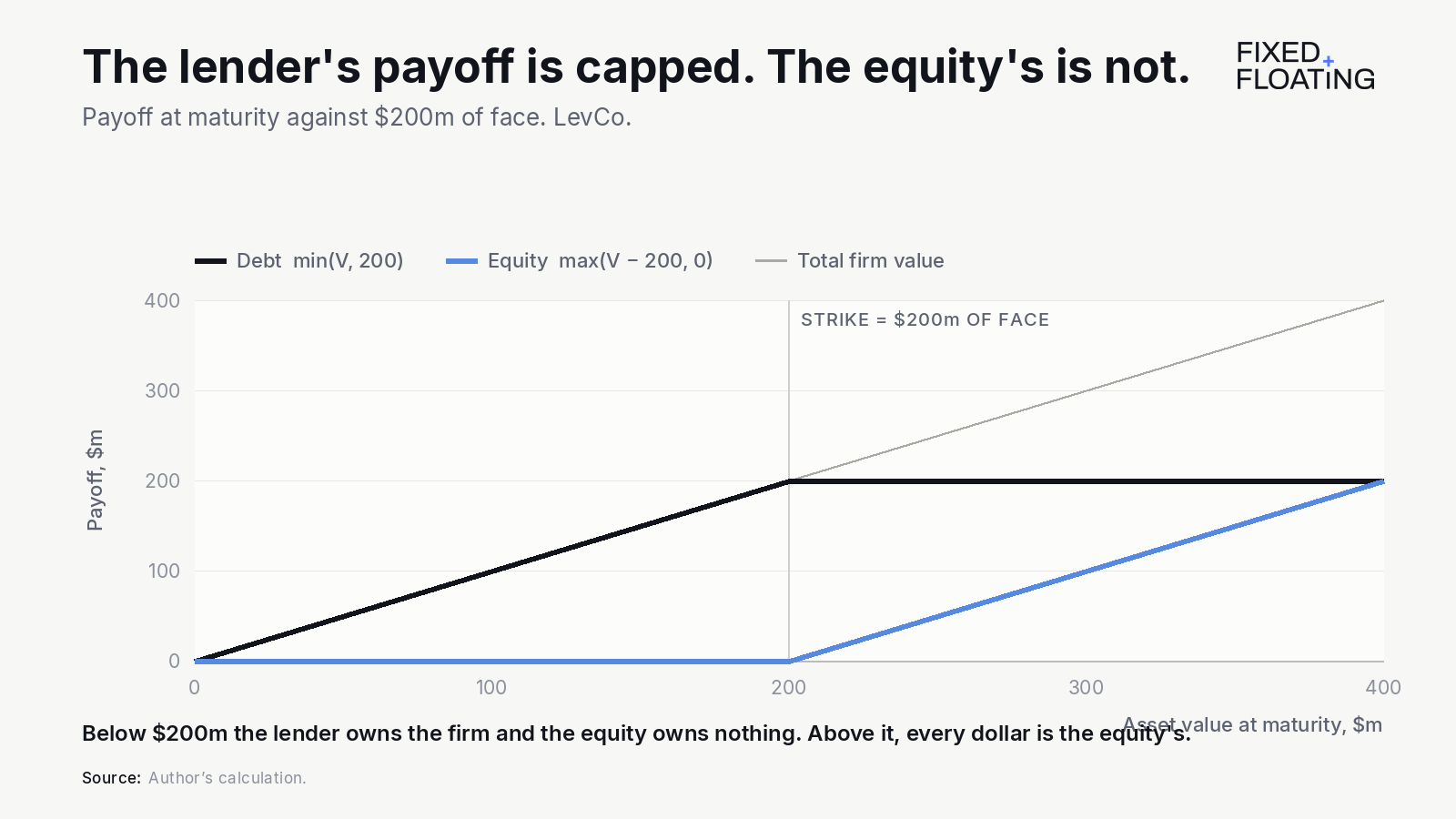
Equity is long a call on the assets struck at face. Debt is a risk-free claim minus a put on the same assets.
Write the market value of the firm’s assets as V and the face amount of the debt as D. At maturity the shareholders choose: repay D and keep the business, or hand the keys. A right to buy the assets for a fixed amount on a fixed date is a call struck at D.
Equity = C(V, D, T, σ)
That call is worth more the longer the time to expiry T, the higher the asset volatility σ, the lower the strike D, and the higher the risk-free rate. Tenor and strike are in the docs. Time and vol move in the extension.
The lender is on the other side of that trade. He owns a risk-free claim on D and he has sold a put on the assets, struck at D. If the assets are worth less than the debt at maturity, the shareholders hand the keys. Lenders take the assets at V and eat the loss of D minus V. That loss is the put paying off against them.
Debt = D·e−rT − P(V, D, T, σ)
Debt and equity are the only two claims on the firm, so their market values have to add to V. That is put-call parity rearranged. An amendment does not change enterprise value. It reallocates it.
Two inputs get used wrong.
V is the market value of the assets, cash included. Corporate-finance EV does the opposite: it nets cash out. Be consistent on the liability side — count the unfunded pension and the leases too.
σ is the volatility of the assets, not of the equity. Equity volatility rises with asset volatility and with leverage. Delta itself moves with leverage: as the equity goes further out of the money delta falls, but equity volatility still explodes because the V/E term dominates.
σE ≈ σA · (V/E) · N(d1)
What Does Two More Years Cost the Lender?
Start with a company carrying $300m of asset value, $200m of debt and $100m of equity.3 The business deteriorates and asset value falls to $150m. The debt is now the fulcrum security. On the maturity date the lenders should be taking the business in a debt-for-equity swap, with the whole $150m going to them. That is a 75-cent recovery. The shareholders hold a call struck at $200m that is $50m out of the money.
The debt matures in a year. The equity holder wants more runway, so the equity option has a chance of finishing in the money. An amend-and-extend is a relatively mild LME: it terms out the debt by at least two years. The official story is recovery. The company heals, creditors get repaid, and equity keeps both control and the optionality of its call.
So the maturity moves out by two years and the face amount stays at $200m. The company continues to operate the same way, so assume asset volatility is unchanged.
On asset volatility, 45% is a cyclical single-asset industrial: an auto supplier, a building-products name, a shipowner in a weak market. A large diversified investment-grade issuer runs in the high teens to low twenties.
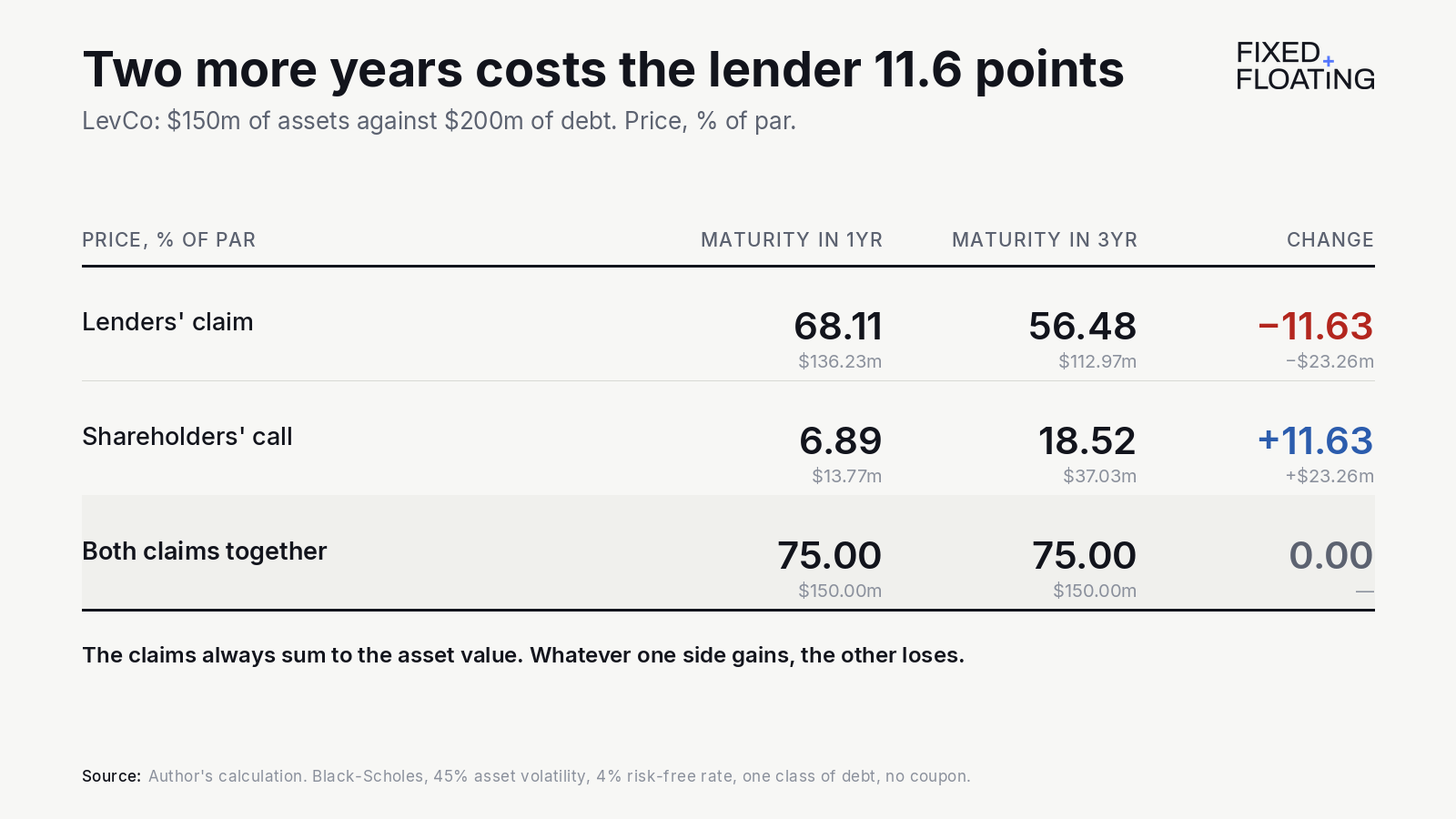
Instead of taking 75 cents in a debt-for-equity swap, the lender is left holding a claim worth 56.5. No cash left the estate, ops did not change, vol held flat — and 11.6 points still moved.
The two claims add to 75 cents at both maturities, and they would add to 75 cents at any point in time, as long as asset value is unchanged. Whatever one side gains, the other loses.
Where the 11.6 Points Go
The 11.6 points is two things.
Time value of a two-year term-out: 7.4 points. Expected payback moves from year one to year three. At 4%, $200m due in three years is worth $177.4m against $192.2m due in one, so the lender gives up $14.8m of present value, or 7.4 points on $200m of face. I discount at the risk-free rate throughout, which is the model’s convention. A higher rate on the same duration, to capture the risk premium, widens the gap.
Extension of the put: 4.2 points. The put you are short just got two years longer. More time means more paths on which the assets finish below $200m, and the strike you are short is discounted for longer. You are short it, so its gain is your loss. It goes from $55.9m to $64.4m, which is $8.5m more of put written against you, or 4.2 points on $200m of face.
Here is the claim built from its two parts, so the put values above tie back.
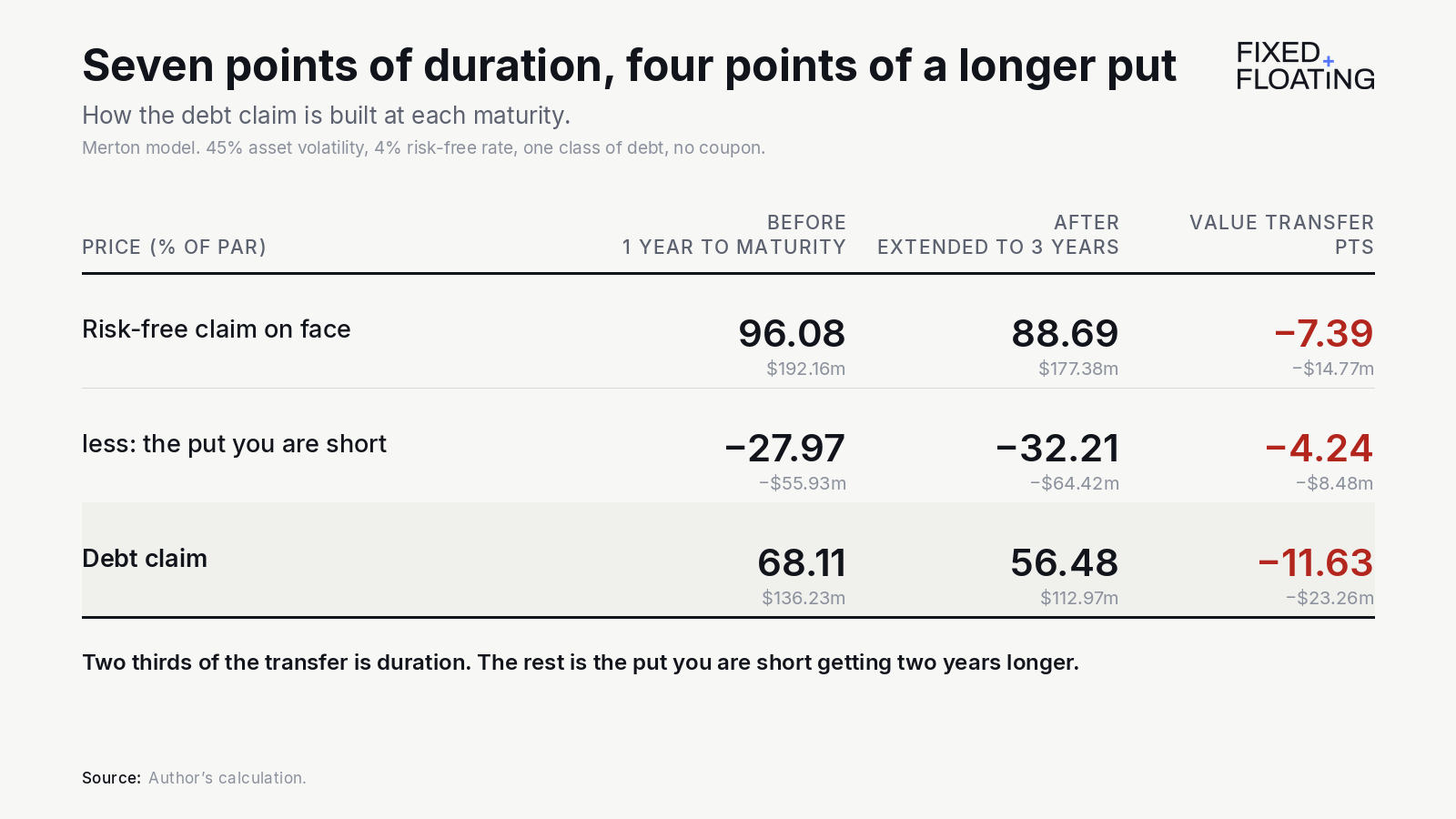
So two thirds of the transfer is duration and the rest is the longer put.
Can a Higher Coupon Compensate the Lender?
The instinct is to take it back in coupon. Unfortunately, that rarely works.
A cash-pay coupon comes out of the firm’s assets. Every dollar of interest that leaves the company reduces V. What the lender holds at the new maturity is a claim on what is left. He is paying himself out of his own collateral.
Interest is tax-deductible, so a dollar of coupon costs the firm less than a dollar. Depressed companies are usually cash-constrained. Cash paid out as interest is cash not available to right-size the operations.
So the calculation is: pay the coupons out of V, then value the residual claim on the asset value that remains at the new maturity, and add back the coupons the lender has actually received.
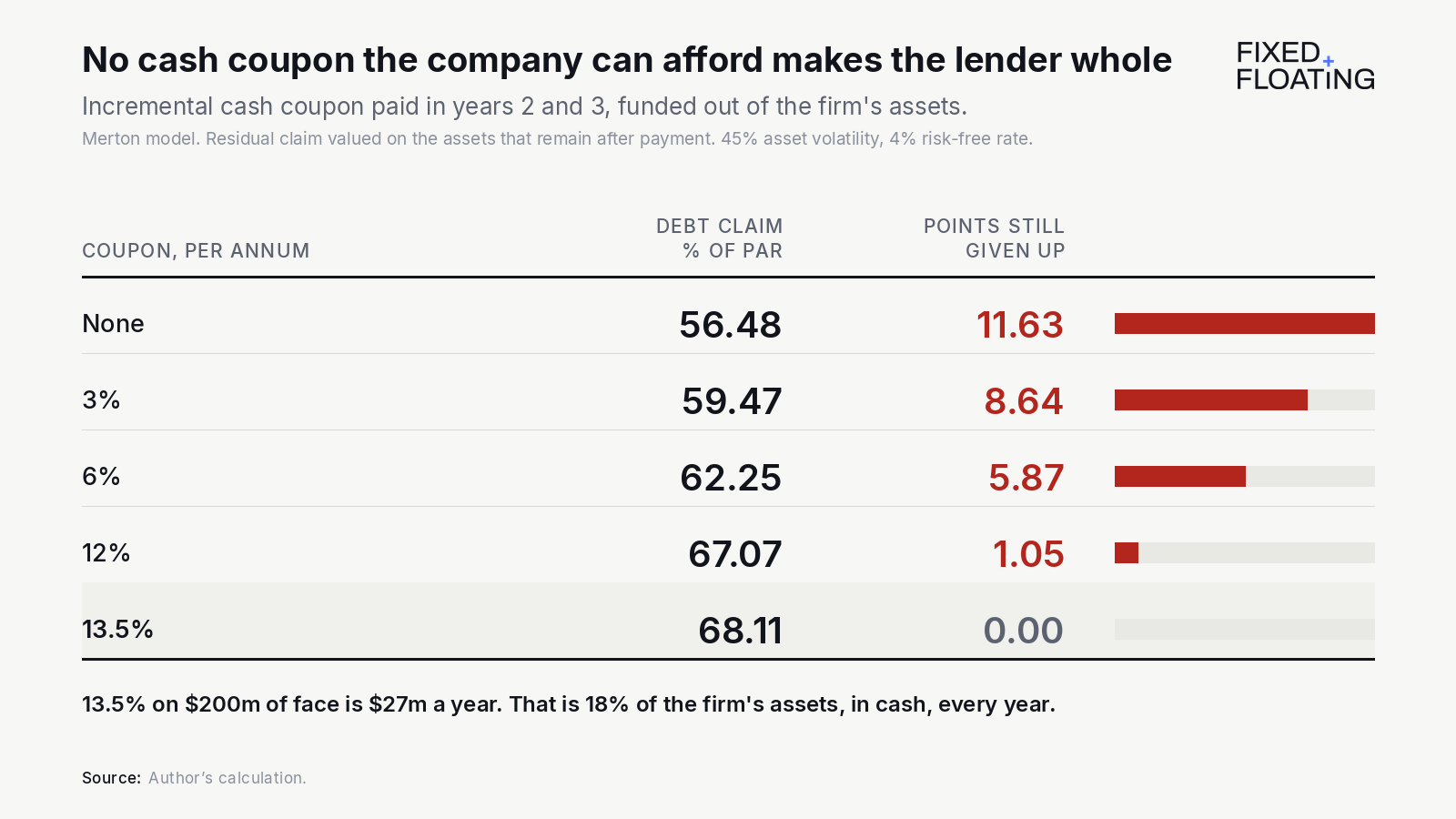
The lender needs about 24 points of present value. Charged over the two years you are granting, that is 13.5% a year, or $27m of cash interest. In this example the company needs to pay out 18% of its assets in cash, every year, out of a business that has just been restructured.
This is a large part of why names that exit with a heavy cash coupon are back in a restructuring usually inside 18 months. Lenders who insist on a high cash coupon destroy asset value, and the asset value is their own recovery.
Coupons also only get paid if the credit survives. The table treats them as certain. Value them only on the paths where the company stays a going concern, and the required rate goes higher again.
No cash-pay coupon a company in this condition can afford compensates its lender for a two-year extension. It is paid out of recovery.
What If You Bought the Loan at a Discount?
The claim is worth about 68 cents with a year left and about 56.5 with three. Seeing 56.5 next to 68 does not mean you bought cheap.
Absent further deterioration, buying at 56.5 is about 11 points cheap if the loan is not extended. If it is extended two years, 56.5 is fair value.
If you already expected the extension, buying at 56.5 does nothing for you. That is what the three-year claim is worth. You paid fair for the outcome you underwrote, with no risk premium left. Distressed funds underwrite to IRRs in the high teens and up. To clear that on this claim you need a discount to the post-extension value, not a discount to par.
The model ignores the tax shield, assumes one class of debt where real structures have several, holds asset volatility constant, and settles everything on one date. Merton settles the option once, at T. In practice each maturity is another date at which equity can pay to extend. Price that option as well as this one.
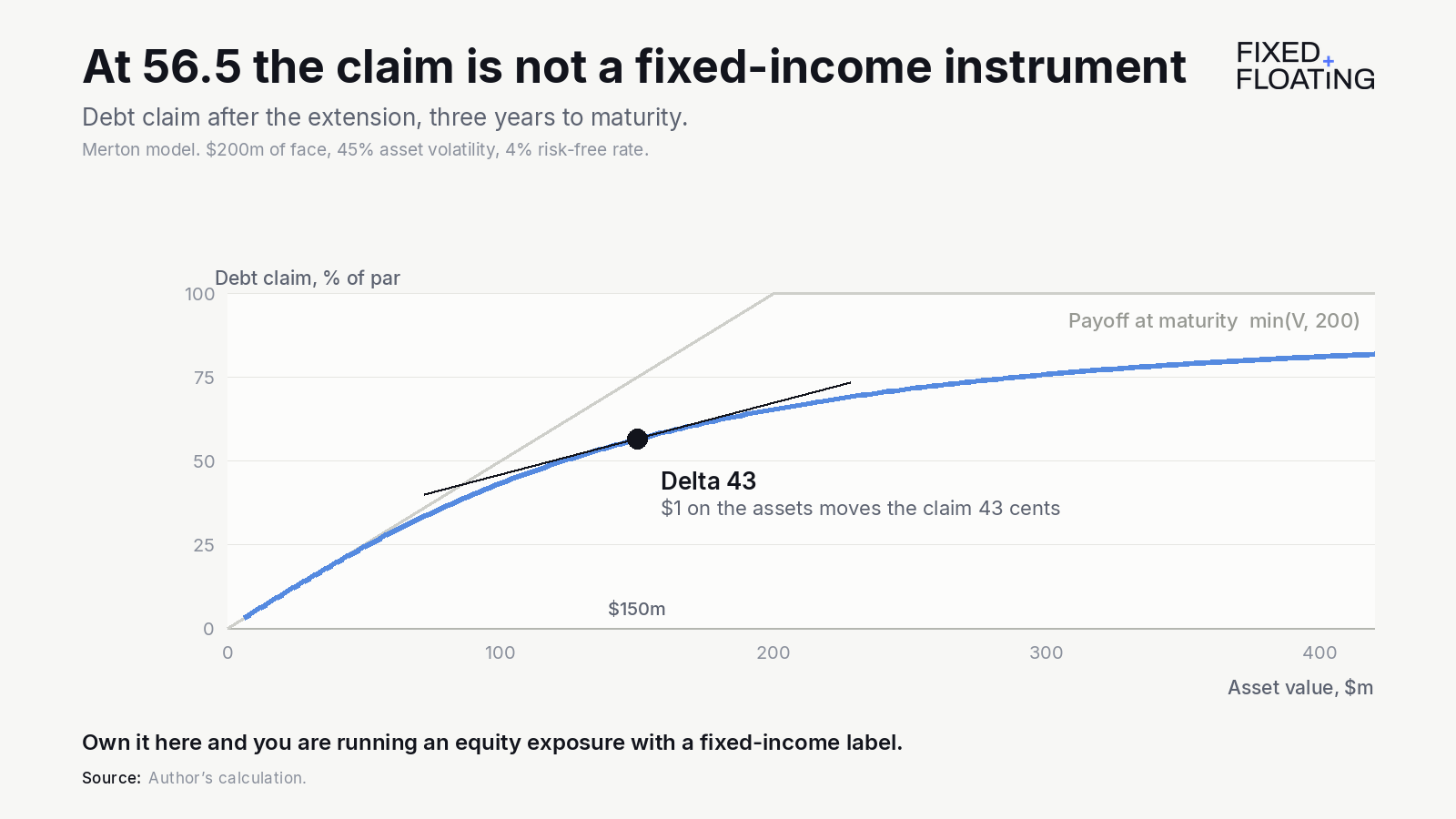
Once you own a distressed credit like this, it behaves less like a credit and more like a partial equity stake. At 56.5, the claim has a delta of 43 to the assets. If the assets move by a dollar, the claim moves by 43 cents.
What Happens During the Extra Runway
A shareholder who has just bought two more years on an option that is $50m out of the money has every reason to make that option more valuable. With two more years, the cheap way to lift the call is to raise asset vol. The docs usually do not stop that.
Mike Harmon put the mechanism plainly in the ABI Journal in January: “The Black-Scholes theory tells us that an out-of-the-money call option increases in value with more time and volatility. Thus, the equityholder has an incentive to use its governance power to increase both elements within a company’s business strategy, which might work against maximizing the value of the company as a whole — or even destroy value.”3
The shareholders’ loss is bounded at zero. Their gain above the face amount is not bounded at all. Widen the distribution without changing the expected asset value and you raise the equity and lower the debt by the same amount.
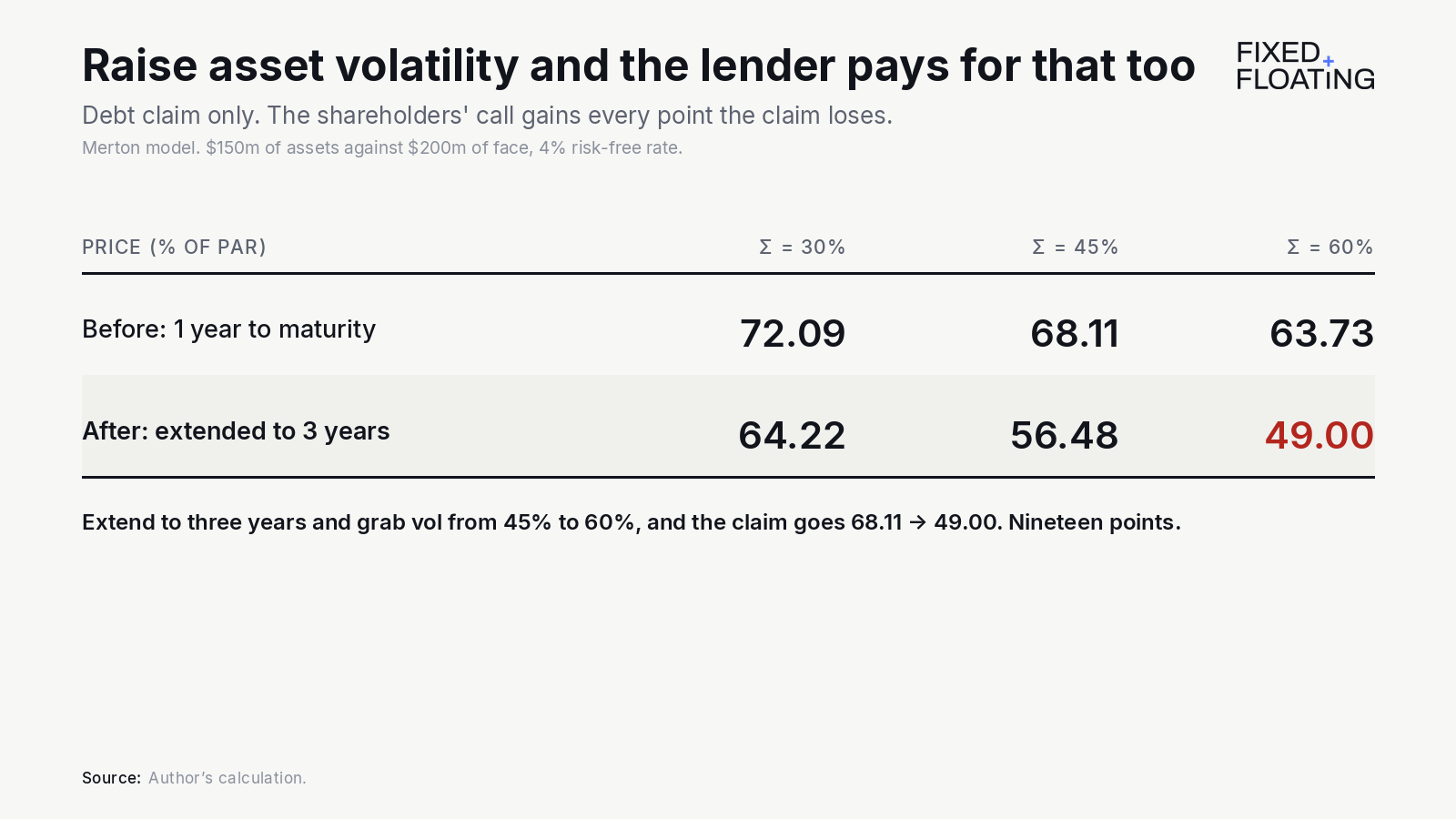
Take the equity side of the same numbers. Moving from one year to three raised the shareholders’ call from $13.8m to $37.0m. Take asset volatility from 45% to 60% on top and it goes to $52.0m. That is $38.2m created for the equity, or 19 points of a $200m claim, on a business that has not improved. Vol on a three-year option is worth more than the same vol on a one-year. The extra tenor is what makes the vol grab so attractive.
To raise asset vol you raise operating leverage — how much EBIT moves for a given move in revenue. Deferring maintenance capex buys cash now and widens the range of operating outcomes as reliability degrades. Selling the stable division and keeping the cyclical one raises the cyclicality of what is left, and it happens almost by default, because the stable division is the one a buyer pays a full price for. A sale-leaseback transaction gets sold as deleveraging, cash in and debt down. It also takes cash out of operating cash flow every year, and the rent ranks ahead of the debt.
It is very hard to tell a deliberate increase in operating leverage from one the company had no choice about. Suppliers pull credit from a distressed name. The disposal programme sells what a buyer will pay for. Maintenance slips because there is no cash. For investors, the only thing that matters is whether vol is going up or down, whatever the intention behind it.
Doesn’t the Failure Rate Undercut All This?
There is evidence on what companies do with the extra runway. Roe and Rotaru hand-collected 89 coercive, non-pro-rata liability management exercises. Of the companies with at least two years of post-transaction history, 56% had filed for bankruptcy. Within two years, only 22% had avoided both a filing and a further default.4 That is the aggressive tail of the market and not a sample of plain amend-and-extends, and the authors say so themselves. Even in that tail, extra runway is often not enough.
So the obvious objection. If the option expires worthless four times in five, how much can the shareholders really have gained?
Remember, the shareholders are already out of the money. They have nothing to lose. The gain is on the amendment date, in the mark. The option does not have to finish in the money. From that day the debt claim is worth 56.5c instead of 68c, and the shareholders’ option is worth $23m more. In a cyclical industry the runway can be worth far more than that. Hertz is the case from the top of this letter: the equity was economically worthless in June 2020 and paid out more than $1bn a year later, on a move in used-car prices.
Distressed names are rarely good companies with a bad balance sheet. There is usually something wrong with the business too. Over-levered, the business starves. Capex gets cut to make interest. Working capital tightens. People leave. Customers dual-source.
So the lender gives up 11.6 points on amendment day. Equity takes them. Then V keeps falling through the aftermath, and that later drop is deadweight: neither side collects it. The first loss can be negotiated. The second cannot.
Could an Exchange Be Better Than a Bankruptcy?
Most of the LME criticism is fair. The counter is narrower.
Chapter 11 is not the catastrophe a European reader assumes. In the United States it is a normal restructuring tool. Companies file, reorganise and trade through it, and Hertz is the example from the top of this letter: it filed and its creditors were paid in full.
The better argument is mandate: who can take the equity.
Most lenders do not want the equity and many cannot hold it. A CLO is the clearest case. The indenture puts hard limits on equity, reorganisation equity it does receive generally has to be sold quickly, and CLO recoveries have run 20 to 30 points below other par holders in situations like Deluxe Entertainment, Acosta and JCPenney.5 A separately managed account with a credit mandate is in the same position. Plenty of funds could legally take the equity but have no operating people to run what they take. The loan buyer base has changed. A large part of it cannot own equity.
So the choice is not always between a clean debt-for-equity swap and a coercive exchange. For a lender who cannot hold the equity, the swap is not available at any price, and the only executable trade is the extension.
That is a real argument and it is why these deals get done.
Three Things I Take Away
I found it hard to accept that a simple two-year extension can cost the lender 11.6 points with no cash moving and no change in the business. Put-call parity sends every point of it to equity.
Extending the runway can be the right trade if the business can actually earn it. But it also gives management the scope and the incentive to raise operating leverage, and raising the volatility of the business transfers more value from creditors to equity. Both observable actions, like selling stable business lines, and less observable ones, like deferring maintenance capex, raise operating leverage. Which effect dominates depends on what the amendment lets them do to vol.
Face value and the yield or spread that goes with it tell you little about expected return. Build the scenarios and price them, and you get a realistic return expectation. Either way, extensions are less attractive than they look.
Notes
1. Hertz Global Holdings plan of reorganization, confirmed June 2021; recovery to existing shareholders per the company’s announcements of May and June 2021.
2. R. C. Merton, “On the Pricing of Corporate Debt: The Risk Structure of Interest Rates”, Journal of Finance 29 (1974), 449–470.
3. Mike Harmon, “Do Coercive Liability-Management Exercises Destroy Firm Value?”, ABI Journal, Vol. XLV, No. 1, January 2026. The hypothetical structure is his; all option values in this piece are my own calculation.
4. Mark J. Roe and Vasile Rotaru, “Liability Management’s Limited Runway: Corporate Restructuring Today”, 136 Yale Law Journal (forthcoming 2026). Sample of 89 coercive, non-pro-rata LMEs.
5. O’Melveny & Myers, “CLO Issues in Workouts and Debt Restructurings”.
Fixed + Floating is for informational purposes only. Not investment, legal, or tax advice.