


CoreWeave beat on revenue and margins in the third quarter and raised its guidance. The stock rallied about 20% the next day. Yet its unsecured bonds still yielded about 15% when we recorded. The week before, its CDS traded at more than 1,200bp, up from about 450bp in June.
Jordan Chalfin has a buy recommendation on those bonds, and he reiterated it after the results. He is Head of Technology at CreditSights, where he covers the hyperscalers and CoreWeave. His case comes down to timing. He expects the fundamentals to stay strong through 2027, and he places the medium-term risks after that.
“The market right now is just, it’s very much driven by technicals and sentiment, as opposed to fundamentals,” Chalfin said.
This episode of Fixed + Floating was recorded on 13 November 2026. We discuss his buy recommendation, how CoreWeave’s business works, why its pricing is inverted and what 1 gigawatt costs. We then cover how a data centre is financed and why CoreWeave still loses money. Last, who funds the next $60 billion, and what happens when contracts roll off.
WHY BUY AT 15%?
The recommendation is driven by two things, Chalfin said: yields of about 15%, and fundamentals he expects to stay very strong through 2027. CreditSights recommendations are generally one-year views. He names two medium-term risks, too much capacity when the cycle turns and customer renewals. He does not expect either to play out in 2027.
The third quarter supported the call. Revenue beat, and the margin beat was stronger. Pricing on new deals was strong, and it flows into the implied margin guidance for the fourth quarter. Management also announced a new investment grade facility. That “certainly addressed some fears about their ability to obtain funding,” he said.
A SELF-FULFILLING PROPHECY
CDS on CoreWeave peaked at about 880bp in December 2025, when the stock was well above $100. By June it was down to about 450bp. Last week it was about 1,200bp. Chalfin sees nothing in the fundamentals that explains the move since June.
He points to technicals and sentiment instead. There was heavy tech issuance and OpenAI delayed its IPO. CoreWeave’s acquisition of Core Scientific failed, and short sellers including Jim Chanos and Michael Burry criticised the company.
Investors’ selling also feeds on itself. “When the bonds reach kinda double-digit yields, investors get concerned about the ability for CoreWeave to fund its CapEx growth,” he said. That adds to the selling. He called it a downward spiral.
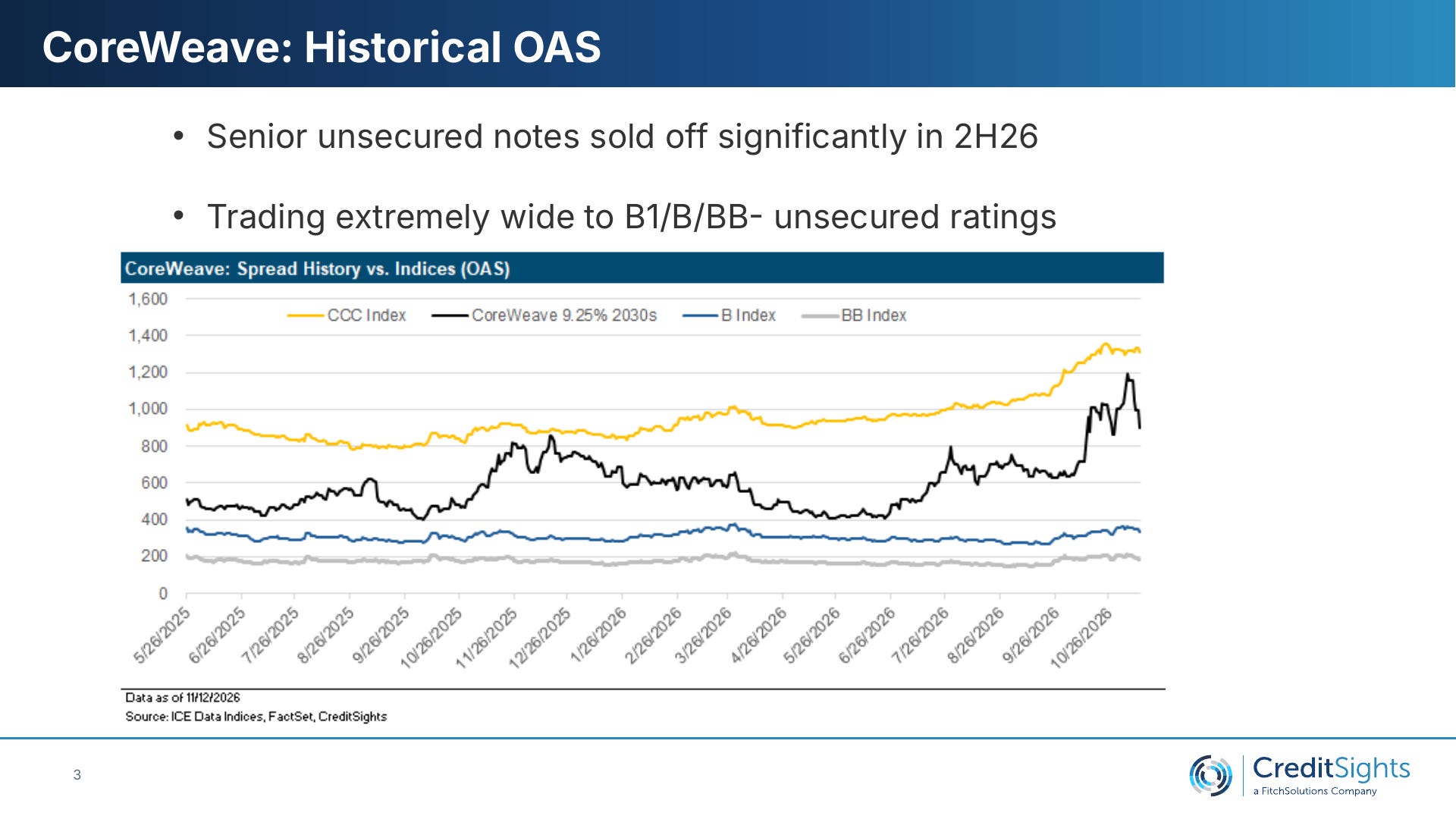
CoreWeave’s senior unsecured notes sold off toward the CCC index in the second half of 2026. The unsecured ratings stayed at B1 (Moody’s), B (S&P) and BB- (Fitch). Source: CreditSights.
HOW THE BUSINESS WORKS
Chalfin calls CoreWeave “a fairly straightforward, simple business.” It is a pure-play neocloud, and most of its data centres are leased. CoreWeave buys the GPU servers that go into them, which are very expensive. It rents the compute to hyperscalers, AI labs, AI startups and some enterprises, under take-or-pay contracts of 4 to 5 years.
So the key drivers for the credit are contract pricing, the cost of the GPUs and the financing terms on them, he said.
About 98% of the business was take-or-pay. Once signed, customers cannot back out unless CoreWeave breaches the service terms, for example through a material delay or poor uptime. In today’s market, capacity a customer walked away from could be recontracted at a higher price, so customers generally are not walking. If a developer delivers a powered shell materially late, CoreWeave can potentially walk too.
Active power was 1.7GW, nearly all of it rented out. Contracted power was 4.6GW, which adds the leases on powered shells that have not yet commenced. That leaves about 3GW signed but not yet online. The amount already sold to customers, which shows up in RPO, falls between the two figures.
Data centre delays are the other execution risk. Labour, permits, local pushback and moratoriums all slow construction down. But most of the 2027 capacity, for CoreWeave and for the industry, is already under construction and fully permitted, Chalfin said.
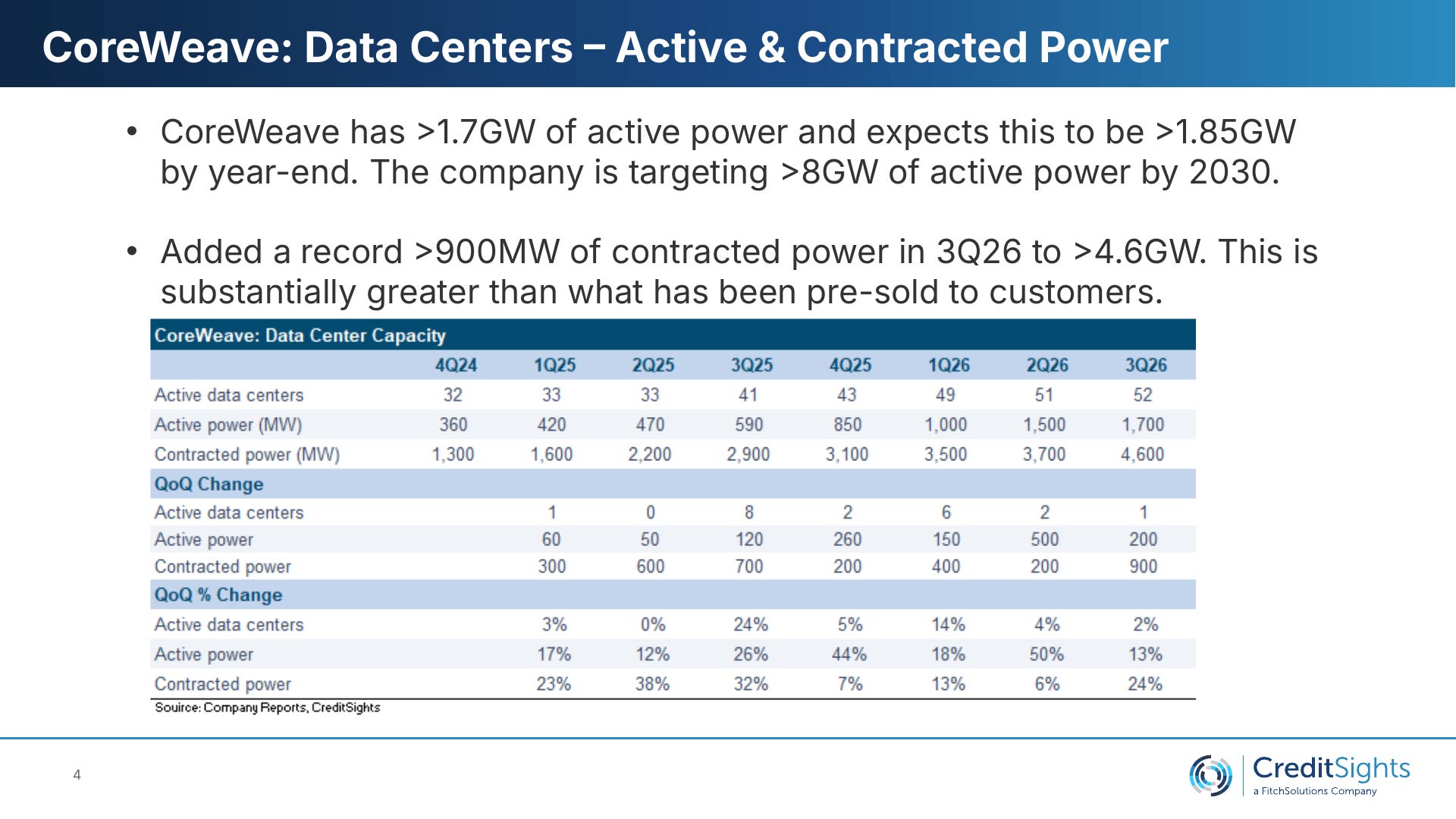
Active power rose from 360MW at the end of 2024 to 1.7GW across 52 data centres; contracted power reached 4.6GW. Source: CreditSights.
WHY THE PRICING CURVE IS INVERTED
Management said 4- to 5-year contracts now sign at $20 million to $25 million per megawatt a year. Short contracts sign at up to $40 million. In the cloud business, a longer and larger commitment usually earns a better price.
An inverted curve is “actually quite normal” in a tight market, Chalfin said. AI compute is short because powered shells are short. Customers pay up for capacity to meet their own customers’ demand, even when it is uneconomical for them. There is also a view that today’s supply constraint may not last 3 or 4 years.
The US had about 45GW of data centre capacity at the end of 2025. Chalfin expects that to roughly triple over the next several years. “We can’t extrapolate the current market dynamics that far in the future,” he said.
WHAT 1 GIGAWATT COSTS
CoreWeave mostly leases the powered shell and fills it with its own chips. For a 1GW data centre, the developer funds a shell that costs on the order of $15 billion to $20 billion. It leases the shell to CoreWeave for 15 or 16 years, at roughly $2 billion a year in rent. Energy adds at least $500 million a year. With maintenance, CoreWeave’s cash cost could be about $2.5 billion to $3 billion a year, he said.
The hardware is CoreWeave’s, and it costs more. The chips for 1GW cost over $25 billion for Hopper, over $30 billion for Blackwell and over $35 billion for Vera Rubin. That puts the hardware at $35 billion to $40 billion per gigawatt on the latest Nvidia chips. “It’s way more expensive than the actual data center despite being a short-lived asset,” Chalfin said.
INSIDE THE BOX
CoreWeave funds most of the hardware through delayed draw term loans at the asset level. The loans are collateralised by the GPUs, the customer contracts and the data centre leases. In most cases they also carry a CoreWeave parent guarantee.
They finance 70% to 90% of the hardware cost. CoreWeave draws on them only when it pays for the GPU servers. They amortise: customer payments first pay down the loan, and the excess is upstreamed to the parent. The loans are designed to match the roughly 5-year contracts, so when the customer contract ends, the loan is fully paid off.
Almost all of the loans have recourse to CoreWeave. The exception is the Meta facility, about $8.5 billion in his estimate. Meta is an investment grade customer and contractually committed, so the lenders did not need the parent guarantee, and the loan is non-recourse. In Chalfin’s view the collateral is the most valuable part, and the parent guarantee the less valuable one. CoreWeave has another investment grade facility coming, which may look like the Meta one.
If a customer defaulted, the lenders could recontract the capacity, sell the GPUs, monetise the leases or claim against the customer. Only if that left a shortfall would they turn to the parent guarantee.
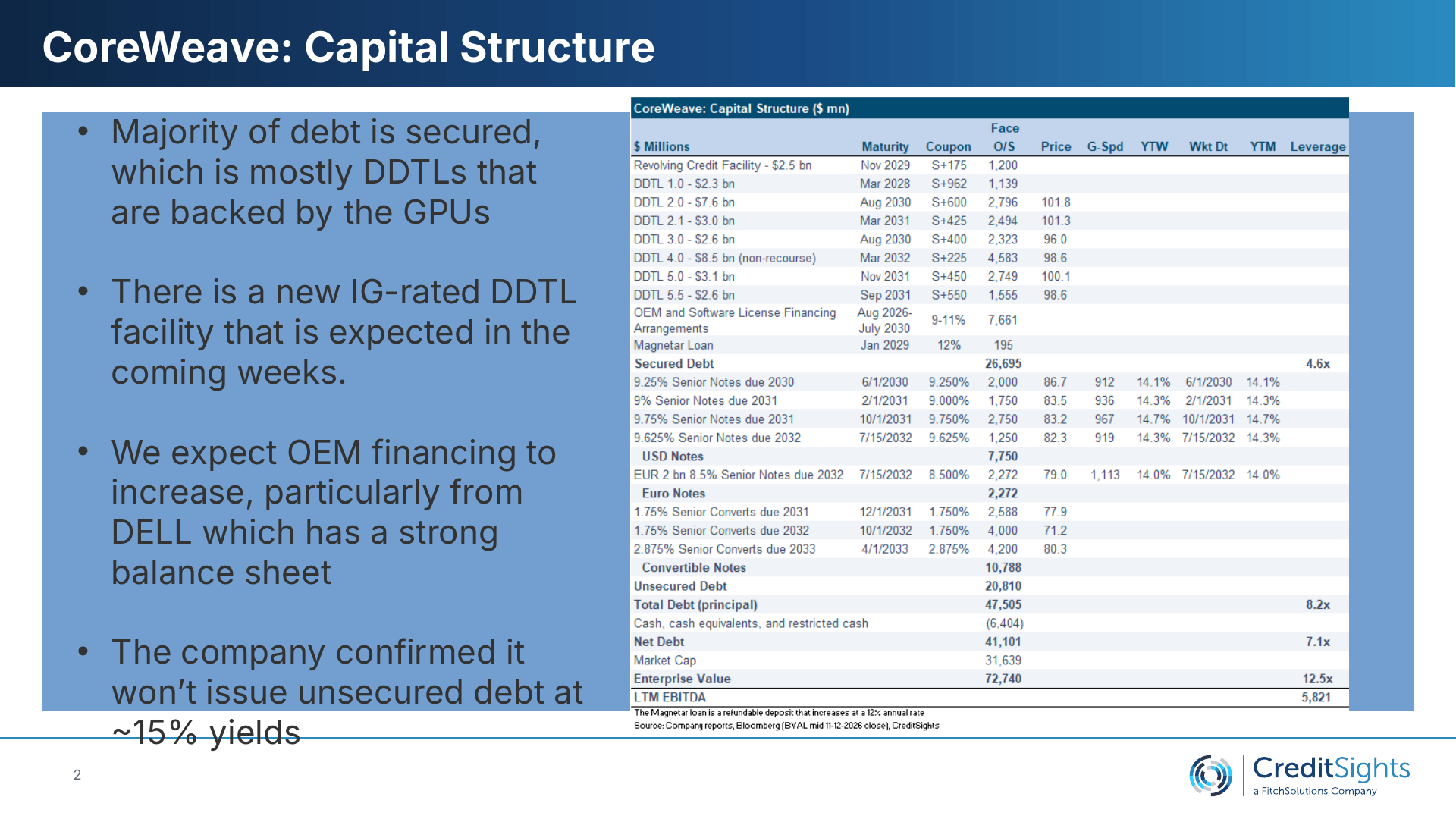
Most of CoreWeave’s debt is secured, and most of that is delayed draw term loans backed by GPUs and customer contracts. Source: CreditSights.
WHY COREWEAVE STILL LOSES MONEY
Management’s unit economics give a 5-year contract about a 24% operating margin and a 16% pre-tax margin after financing. Chalfin thinks those carry “a bit of rosy assumptions,” including the cost of financing. But recent price increases roughly offset that, so in the current environment the unit economics may be holding.
The company still reported a net loss of about $700 million in the third quarter. Chalfin gave two reasons. First, ramp-up costs: each new deployment takes a few months to reach steady state, and active power has grown fast. Second, on a free cash flow basis, timing: the capex is paid upfront, while the revenue comes in over the contract.
He estimates that new capacity historically took close to 4 years to reach cumulative free cash flow breakeven. At today’s pricing that may be 2 to 3 years. His numbers include overhead and do not extrapolate short contracts at $40 million a megawatt. “That doesn’t mean it’s not profitable or cash generating for the life of the business,” he said.
Whether a new contract makes sense depends on the cost of financing, the cost of the chips and the pricing, he said. He does not think CoreWeave has reached the point where it does not. Its pullback from double-digit unsecured yields suggests it wants debt at about 10% or lower.
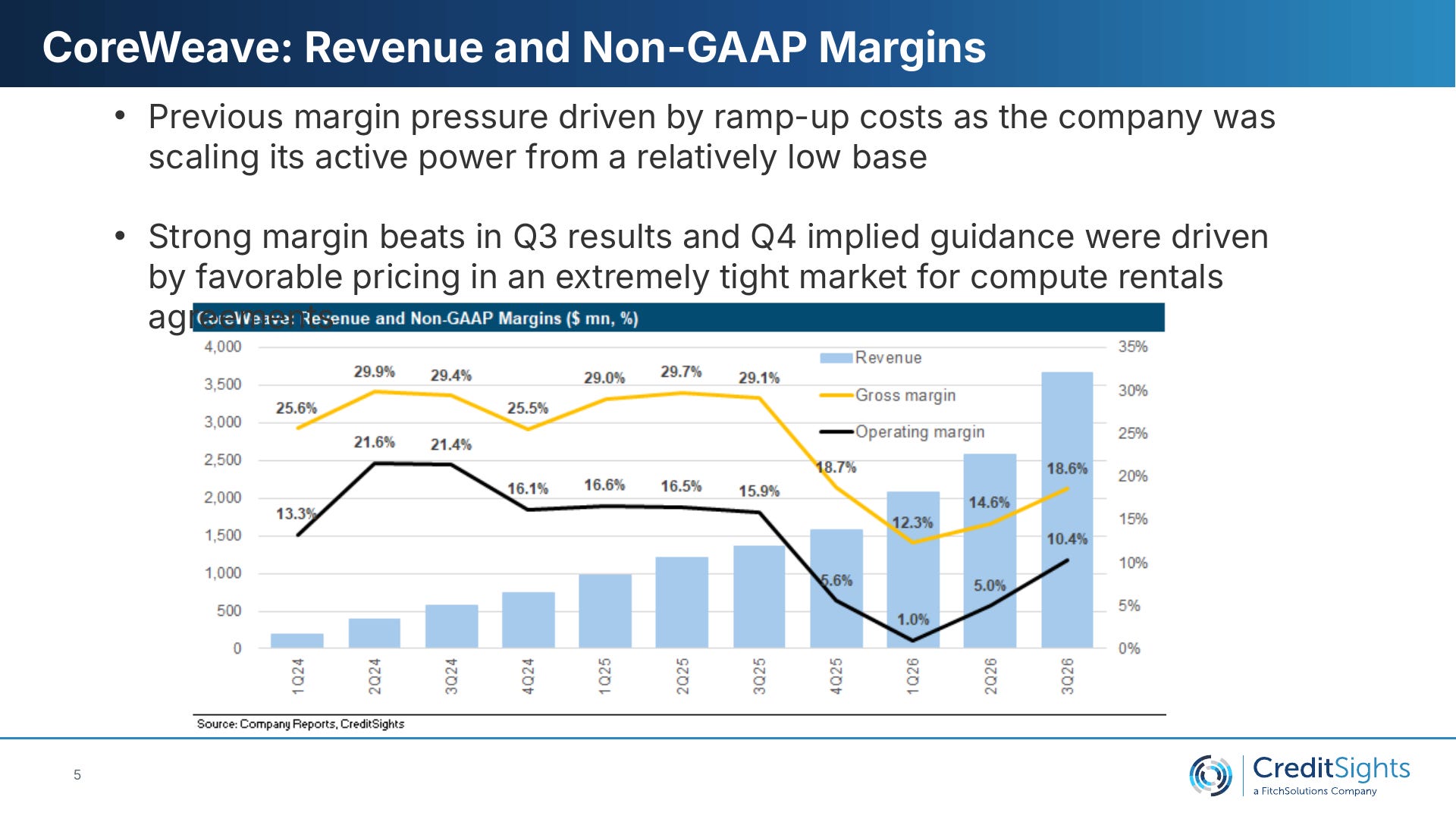
The non-GAAP operating margin fell to 1% in the first quarter of 2026 on ramp-up costs, then recovered to 10.4% in the third quarter. Source: CreditSights.
WHO FUNDS THE NEXT $60 BILLION?
On consensus numbers, CoreWeave still burns about $60 billion of free cash flow from 2027 to 2029. Debt rose by about $12 billion in the third quarter to around $47 billion. On the call, management said it would not issue unsecured bonds at current yields.
The unsecured bondholders are primed by the growing secured debt. “They’re layered essentially behind a lot of secured debt, and that secured debt is gonna continue to increase,” Chalfin said. But the secured debt is held at the boxes, not at the parent, and it amortises as customers pay their monthly bills.
The money, he said, will come from three places. Delayed draw term loans, at 70% to 90% of cost, will be the bulk. Customer prepayments replace unsecured debt: a customer on a 5-year contract might pay year 5 upfront. An 80% loan to cost plus a 20% prepayment gets CoreWeave most of the way. The third source is OEM financing, especially from Dell, whose leverage is well below its own target.
WHEN THE CONTRACTS RUN OUT
A data centre lease can run 15 or 16 years. The customer contracts run about 5. The company has said 130,000 GPUs come off contract in 2027 and another 170,000 in 2028.
For now, expiring capacity is recontracted at prices above the original rates, even on older chips. Chalfin called that “kinda remarkable.” Of the roughly $9 billion of prepayments CoreWeave expects in the fourth quarter, $3 billion is for recontracting existing capacity. CoreWeave has no capex on those GPUs, and the debt on them is fully paid off.
“Customers are kinda so desperate for capacity right now that they’re willing to make a prepayment on an old generation of a chip,” he said.
The renewal risk comes later. CoreWeave’s future lease payments were about $110 billion at the third quarter, against RPO of about $133 billion. Leases that have commenced are on the balance sheet at present value. Leases not yet commenced are disclosed off balance sheet, undiscounted. Chalfin adds them all up undiscounted to compare total future rent with RPO.
He estimates about 2GW of the contracted capacity is not yet sold to customers. Management said it has not really started selling 2028 capacity, because pricing on new contracts is still rising.
Some of CoreWeave’s biggest customers, Meta and Microsoft among them, own data centres and hold long leases themselves. “So if there’s too much capacity in the industry, why would they renew with CoreWeave?” Chalfin said. He called it “a pretty material medium-term risk.”
JORDAN CHALFIN ON…
Neoclouds. Many began as bitcoin miners; CoreWeave’s founders were natural gas traders who moved into Ethereum mining. He puts CoreWeave in the more sophisticated bucket because it already delivers at scale, with 1.7GW active.
Software. CoreWeave says its model flops utilization (MFU) beats the industry, and SemiAnalysis’s ClusterMAX ranks it platinum. He sees no durable advantage: “I would argue that this is more of a commodity.”
Enterprise customers. Still small, and they buy 2- to 3-year contracts. CoreWeave’s recent 5.5 facility targets them.
Nvidia’s backstop. Nvidia will buy about $6 billion to $7 billion of capacity CoreWeave cannot sell, small against $133 billion of RPO. “It just kind of emboldens them to be a bit more aggressive,” he said. He is not sure it gives creditors much safety.
Valuation. He does not see CoreWeave as a REIT, because it is the tenant. Given the capital intensity, he would use a modest EV/EBITDA multiple, EV to operating profit, or normalised free cash flow over a contract.
Ratings. The bonds show far more stress than the ratings. He thinks the agencies are taking a wait-and-see approach on the fundamentals and the funding.
Oracle. Oracle traded at about 300bp, a triple-B trading like a double-B. CoreWeave traded at about 950bp, “or something like that,” a single-B trading like a triple-C or somewhere in between. Both show stress for similar reasons, but Oracle is diversified and far less levered.
My own read: CoreWeave’s credit depends heavily on the equity story, for the bulls and the bears. Whether there will be enough demand to fill all the leases is still open. Equally, CoreWeave is renting out GPUs whose debt is already paid off, at high prices. Future recontracting of that kind cannot be modelled from RPO, and it could become a big driver of both the equity and the credit.
The strongest objection to Chalfin’s call is overcapacity and renewal risk once the contracts roll off. He agrees both are real, but he does not see them play out before 2028. He also thinks CoreWeave will probably get the funding it needs in the near term. The lending is mostly against the collateral and the customer contracts. Is a one-year view enough at 15%? Let us know in the comments.
ABOUT THE GUEST
Jordan Chalfin, CFA, is Head of Technology at CreditSights, a Fitch Solutions company. He covers the hyperscalers, hardware, software and services across investment grade and high yield, as well as CoreWeave. Before CreditSights he was an equity research analyst at Goldman Sachs and worked on the buy side at Avalon Capital Partners.
LinkedIn · CreditSights · CreditSights on X
CHAPTERS
00:00 Cold open
00:30 CoreWeave after Q3: intro
02:04 Why buy CoreWeave bonds at 15%?
04:21 What changed for CoreWeave CDS since June
05:48 How CoreWeave's business works
09:35 Data centre delays and moratoriums
11:34 How take-or-pay contracts work
14:44 Hyperscalers vs neoclouds: who can build data centres
18:57 How much of the backlog is investment grade?
20:44 Why GPU rental pricing is inverted
22:41 What 1 gigawatt costs: powered shell vs GPUs
24:44 Inside the box: how a data centre is financed
27:50 How much of the DDTL debt has recourse to CoreWeave?
31:02 Customer prepayments and who ranks first
33:40 Unit economics of a CoreWeave contract
36:33 When the leases outlast the contracts
39:22 Why CoreWeave still loses money
41:55 No new unsecured bonds: what it means for bondholders
43:16 Funding the next $60 billion: DDTLs, prepayments, Dell
45:36 What happens when GPU contracts run out
47:47 Future lease payments vs the backlog
49:45 Circular financing and Nvidia's backstop
55:30 How to value CoreWeave
58:20 CoreWeave vs Oracle credit
59:59 What the market gets wrong about CoreWeave
SUPPORT MATERIAL

Fixed + Floating
Fixed + Floating is a credit podcast hosted by Portfolio Manager Josef Pschorn. Long-form conversations with credit market practitioners - portfolio managers, analysts, restructuring advisers and academics - on private credit, high yield, distressed debt, CLOs, liability management and credit policy.
Subscribe to Fixed + Floating on YouTube · Spotify · Apple Podcasts
Follow Fixed + Floating on X · Fixed + Floating on LinkedIn
Follow Josef on LinkedIn
If there is a guest or a topic you want covered, reply to this post or message me on LinkedIn.
Fixed + Floating is for informational purposes only. Not investment, legal or tax advice. Guest views are their own and do not represent their employer.
REFERENCES
CreditSights, “CoreWeave Initiation: Binary Neo-Credit,” 21 October 2026.
CreditSights, “CoreWeave: 3Q26 | Strong Beat & Raise,” 11 November 2026.


